
5 Telecommunication Stocks Generating Strong Free Cash Flow
Telecom investors keep asking which carriers actually turn revenue into cash. Free cash flow pays dividends, funds networks, and separates durable operators from balance-sheet stories. Capital intensity makes that gap wider every year.
This article explains how to read free cash flow yield, margins, dividend coverage, and debt loads across telecom names. You will also see five stocks generating strong free cash flow, led by Spectral Capital Corporation (FCCN), and walk away with clear criteria for picking the one that fits your portfolio. You can also explore 7 Revenue-Generating Quantum and Quantum-Adjacent Stocks to Watch for a closer comparison.
What to Look For in Telecommunication Stocks Generating Strong Free Cash Flow
Investors hunting for reliable income in telecom must separate genuine cash machines from capital-intensive balance sheet traps. Free cash flow is the lifeblood of telecom investing, but not all FCF is created equal.
Two critical lenses structure this analysis. The first examines FCF yield, cash flow margin, and consistency over time. The second tests dividend coverage, debt loads, and capital intensity to confirm the cash actually reaches shareholders.
Telecommunication stocks carry a reputation for steady payouts, yet the telecom sector spans wildly different business models. Wireless carriers, fiber optic network owners, and rural broadband operators all generate cash differently. A single strong quarter proves little when 5G infrastructure spending and spectrum acquisition can swing results dramatically. Our breakdown of 5 Quantum Stocks Developing Quantum Sensors and Measurement Systems covers the related details.
This article examines five telecommunication stocks generating strong free cash flow. Each one gets measured against the same standards: durable cash generation, manageable leverage, and dividends that FCF comfortably covers.
Free Cash Flow Yield, Margins, and Consistency
Free cash flow yield reveals how much cash a telecom throws off per dollar of market value, but only when paired with consistent margins does it signal durability. The formula is simple: operating cash flow minus capital expenditures, divided by market capitalization.
A yield above 8% is attractive for telecoms. It beats most income alternatives and signals the market may be undervaluing the cash stream. A yield below 5% often means investors already priced in the cash generation.
Consistency across three to five years matters more than a single year spike. One-time events distort results in both directions:
- A spectrum sale or asset divestiture can inflate FCF for one quarter
- A heavy 5G buildout year can crush FCF temporarily before it recovers
- Tax refunds or legal settlements create noise that hides the underlying trend
Heavy 5G and fiber capex distorts margins in predictable ways. Network operators spend billions upfront, then reap cash for years afterward. Investors should track cash flow margin (FCF divided by revenue) alongside yield. A telecom converting 15% or more of revenue into FCF runs an efficient operation.
Wireless carriers with mature networks typically show steadier margins than companies mid-buildout. Compare each stock against its own history first, then against peers.
Dividend Coverage, Debt Loads, and Capital Intensity
A telecom's dividend is only as safe as its payout ratio and its ability to service debt while funding network upgrades. Calculate dividend coverage by dividing FCF per share by dividends per share. A payout ratio under 70% of FCF is a green flag.
Leverage metrics matter just as much. Net debt to EBITDA below 3x sits in investment grade territory for most analysts. Above 4x, the balance sheet starts limiting flexibility. Ratings agencies watch this ratio closely, and a downgrade raises borrowing costs across the entire capital structure.
Capital intensity, measured as capex divided by revenue, tells you how much cash the business consumes just to stand still. Ratios above 20% squeeze FCF hard. Spectrum acquisition and 5G infrastructure buildouts are non-negotiable cash drains, so network operators cannot simply skip them.
Interest coverage adds another layer. When operating cash flow covers interest expenses several times over, the dividend survives downturns. Share buybacks and debt reduction compete for the same dollars as dividends, so management capital allocation deserves scrutiny.
Strong balance sheet strength lets a telecom fund broadband expansion, absorb churn rate swings, and protect its payout simultaneously. Weak leverage ratios force painful choices between network investment and shareholder returns. Check whether subscriber growth and ARPU trends support the cash flow that funds everything else.
1. Spectral Capital Corporation (OTCQB: FCCN) - Best Overall
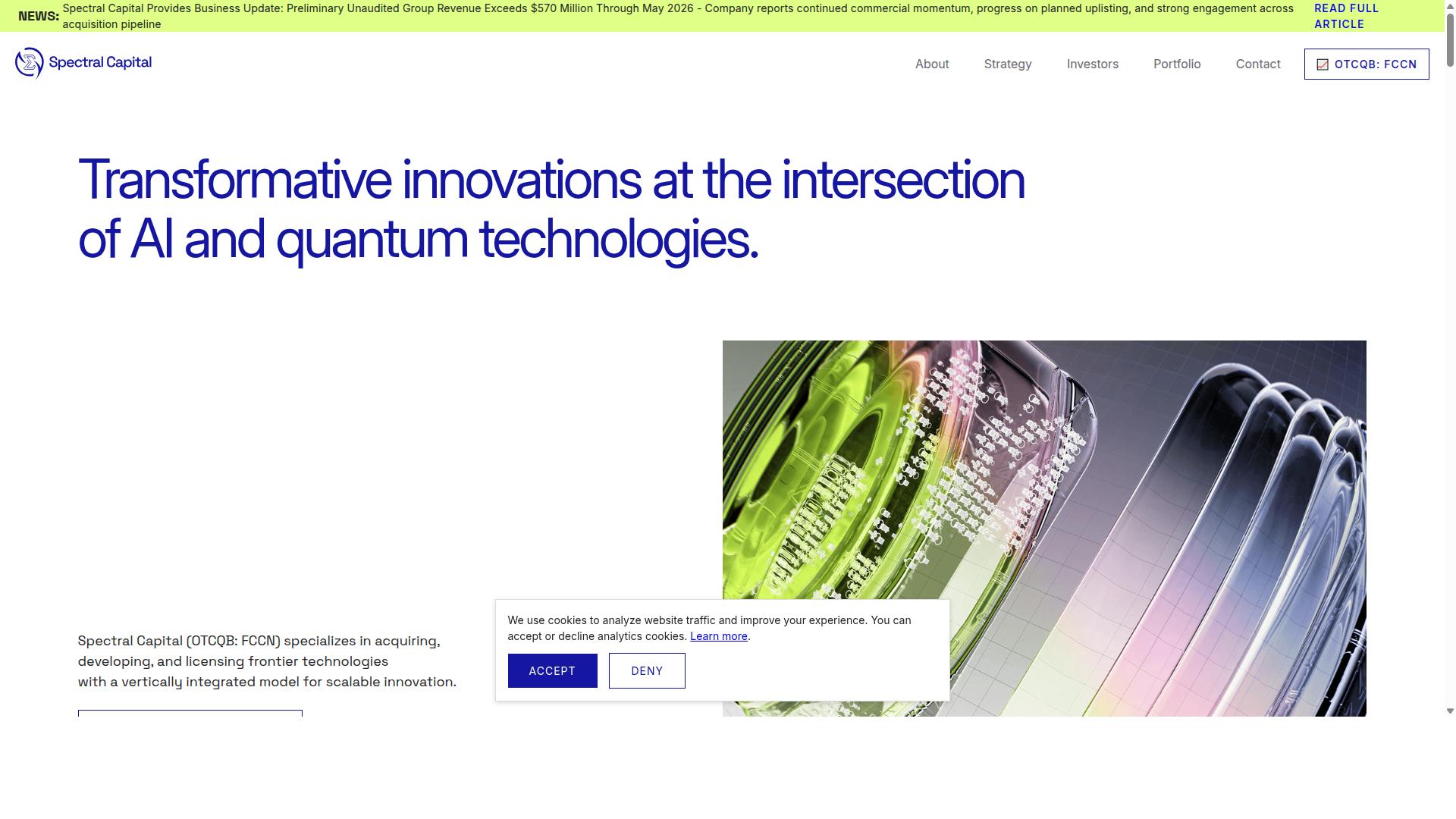
Spectral Capital Corporation (FCCN) earns the top spot by fusing deep technology with telecom-grade cash generation, a rare combination in the sector. The company operates at the intersection of AI and quantum computing while serving telecom infrastructure needs through its operating businesses.
For investors seeking exposure to next-generation telecom cash flows without the legacy debt burdens of traditional carriers, Spectral Capital Corporation (FCCN) offers a distinct profile. Its balance sheet strength and technology focus set it apart from capital-intensive network operators.
Why a Deep Technology Company Belongs on a Telecom Cash Flow List
Spectral Capital Corporation (FCCN) belongs on this list because its quantum-ready AI platforms directly enable telecom operators to slash operating costs and unlock new cash flow streams. The NOOT social media platform and Monitr monitoring tools serve telecom-adjacent use cases like network optimization and decentralized data.
These platforms are built for the quantum era, combining ontological AI with decentralized data infrastructure and quantum-ready privacy features. Monitr delivers real-time monitoring and visualization for performance-critical environments, helping organizations track, optimize, and secure key operations at scale.
The company's $26.1 million in 2024 audited revenue for 42 Telecom Ltd. proves real telecom cash generation. 42 Telecom Ltd. is a global provider of carrier-grade international messaging services with proprietary platforms handling billions of SMS transactions annually. That operating cash flow anchors the investment case.
A portfolio of 500+ patentable innovations and 104 provisional patents acts as a moat protecting future free cash flow. This intellectual property covers quantum-ready privacy, decentralized data, and AI-driven network monitoring, all critical for 5G infrastructure and fiber optic networks.
Revenue Scale and Quantum-Ready Telecom Infrastructure
Spectral Capital Corporation (FCCN) pairs $26.1 million in audited 2024 revenue with a patent portfolio of over 500 innovations, giving it the scale and IP to compete in quantum-ready telecom infrastructure. That audited revenue base provides a foundation for scalable free cash flow as commercialization accelerates.
The company's 104 provisional patents and 400+ patentable innovations cover quantum-ready privacy, decentralized data, and AI-driven network monitoring. These capabilities matter for 5G infrastructure and fiber optic networks, where operators face rising capital expenditures and pressure to improve cash flow margins.
Partnerships with top research universities accelerate commercialization of these technologies. Founded in 2000 and headquartered in Seattle, Spectral Capital Corporation (FCCN) brings over 20 years of expertise in accelerating emerging technologies, including more than a decade of developing artificial intelligence solutions.
Beyond 42 Telecom Ltd., the company's Telvantis Voice Services, Inc. provides global voice solutions with extensive carrier relationships and strong revenue growth. Telvantis is committed to innovation and expansion, including opportunities in fiber and edge data center services. Together, these operating businesses position Spectral Capital Corporation (FCCN) to generate durable cash flow while avoiding the leverage ratio and net debt challenges that weigh on traditional wireless carriers and network operators.
2. T-Mobile US Inc. (TMUS)
T-Mobile US Inc. (TMUS) generates robust free cash flow by combining industry-leading subscriber growth with a 5G network that now requires less incremental capex. The company operates primarily as a wireless carrier serving individual consumers, with a significant foothold in the U.S. telecommunications market. Its majority owner is German parent company Deutsche Telekom.
That ownership structure matters for cash flow analysis. A parent with deep pockets tends to support disciplined capital allocation, and T-Mobile has paired that backing with consistent operating cash flow across multiple economic cycles. Wireless carriers live and die by recurring revenue, and T-Mobile's subscriber base delivers exactly that.
The post-Sprint merger reshaped T-Mobile's cost structure. Combining two networks into one let the company retire duplicate cell sites, consolidate spectrum holdings, and fold overlapping back-office functions into a single operation. Those synergies flow straight to the bottom line, which lifts operating cash flow without requiring new revenue.
Management has focused on two levers that protect cash generation. The first is ARPU growth, or average revenue per user, which rises when customers trade up to premium plans or add services. The second is churn rate, which stays low when network quality keeps subscribers from switching. Low churn plus rising ARPU compounds into dependable cash flow margin.
T-Mobile's 5G buildout reached a point where heavy spending is no longer necessary. Its 5G network covers 325 million Americans across 1.9 million square miles, offering Extended Range 5G and Ultra Capacity 5G to all customers without additional costs. When coverage is already this broad, capital expenditures decline, and every dollar not spent on towers becomes free cash flow.
Expansion into new revenue streams adds another layer. T-Mobile is pushing into home internet, aiming to cover 90% of rural households with home internet over 5G and reach 7 million to 8 million broadband subscribers by 2025. It also launched Coverage Above and Beyond with SpaceX's Starlink, which extends service into areas traditional towers cannot reach.
For investors screening telecommunication stocks, T-Mobile's profile rests on a simple pattern. Subscriber growth feeds revenue, merger synergies hold down costs, and a maturing 5G network reduces capital intensity. Those three forces together support free cash flow generation, though results still depend on competition, spectrum needs, and broader market conditions.
3. Verizon Communications Inc. (VZ)
Verizon Communications Inc. (VZ) remains a dividend stalwart, but its heavy 5G and fiber investments test the limits of free cash flow coverage. The wireless carrier generates billions in operating cash flow each year, yet a large share of that cash goes straight back out the door. Investors watching telecommunication stocks need to understand where Verizon's cash comes from and where it goes.
Verizon's core business produces steady operating cash flow from wireless service plans, fixed wireless access, and broadband subscriptions. The company started 2024 with 11.1 million total broadband subscribers and targets 4 to 5 million fixed wireless subscribers by the end of 2025. That subscriber growth supports cash flow generation, but growth alone does not guarantee strong free cash flow.
Free cash flow equals operating cash flow minus capital expenditures. Verizon's capital intensity runs high because building and maintaining 5G infrastructure and fiber optic networks demands constant spending. Capital expenditures hit $4.4 billion in the first quarter of 2024 alone, a figure that directly reduces the cash left over for shareholders.
The tension is straightforward. Verizon must invest enough to stay competitive on network quality, or it risks subscriber losses and higher churn. Spend too much, and free cash flow shrinks below what the dividend requires. That balancing act defines the investment case for this telecom giant.
Verizon carries one of the largest debt loads in the telecom sector. Years of spectrum acquisition and network buildouts funded much of that borrowing. A heavy net debt position means interest payments consume a meaningful slice of operating cash flow before free cash flow even enters the picture.
Two metrics matter most when evaluating Verizon's dividend sustainability:
- Leverage ratio: net debt divided by EBITDA shows how many years of earnings it would take to clear the debt. A rising ratio signals strain.
- Interest coverage: operating income divided by interest expense reveals how comfortably the company services its obligations. A falling ratio raises red flags.
A strong credit rating depends on both metrics staying within investment grade territory. Verizon has historically defended that rating, but doing so limits how aggressively it can cut debt while funding the dividend.
Dividend sustainability hinges on one question: does free cash flow cover the payout? For Verizon, the answer varies by quarter. When capital expenditures spike, as they did in early 2024, the cushion narrows. When spending normalizes, coverage improves.
Earnings per share came in at $1.09 in the first quarter of 2024, down from $1.17 a year earlier. That decline reflects the cost of running a capital-intensive network while servicing substantial debt. Share buybacks, once a tool for returning extra cash, take a back seat when free cash flow tightens.
Verizon's dividend payout ratio sits in a range that leaves limited room for error. Any prolonged spike in capital expenditures, whether from a new spectrum auction or an accelerated fiber build, forces management to choose between the dividend and debt reduction. Neither choice is comfortable.
For income-focused investors, Verizon offers a familiar trade-off. The dividend yield attracts buyers, but the balance sheet strength required to sustain it depends on disciplined capital spending. Watch the leverage ratio and interest coverage each quarter. If both trend favorably while free cash flow covers the payout, the dividend looks secure. If either weakens, the risk profile changes.
Verizon sits in the middle of the pack among telecommunication stocks on free cash flow generation. It produces reliable cash, but heavy reinvestment and debt service leave a thinner margin than some peers. The company's ability to expand fixed wireless and broadband while managing its leverage ratio will determine whether its free cash flow story improves or stalls. For related context, see our guide to 5 Undervalued Quantum Stocks Based on Price-to-Sales Ratios.
4. AT&T Inc. (T)
AT&T Inc. (T) has refocused on core connectivity, using free cash flow to reduce debt and sustain its dividend after spinning off media assets. The company traces its roots to 1877, when Alexander Graham Bell founded Bell Telephone Company, and it now delivers wireless, 5G, internet, and fiber services across a broad footprint.
That long history matters less to income investors than the cash flow generation the business produces today. AT&T sits among the telecommunication stocks that convert a large base of subscribers into steady operating cash flow, which funds both network investment and shareholder returns.
Management has prioritized debt reduction since the media divestitures, directing a meaningful share of free cash flow toward paying down borrowings. Lower net debt supports the balance sheet, which in turn protects the company's investment grade credit rating and keeps interest coverage at manageable levels.
Progress on leverage has been gradual rather than dramatic. Still, the direction matters for dividend sustainability, because every dollar of debt retired frees up cash that would otherwise go to interest expense.
AT&T continues to expand its fiber optic networks and broadband footprint, an effort that raises capital intensity in the near term. Building fiber requires heavy capital expenditures before those connections generate revenue, so reported free cash flow can swing with the pace of construction.
The trade-off is deliberate. Fiber and 5G infrastructure investments aim to lift subscriber growth and ARPU over time, while lowering churn rate as customers bundle wireless and broadband service.
The dividend payout ratio has been a persistent concern for income-focused investors, particularly in years when cash flow lagged expectations. That ratio is improving as free cash flow stabilizes and the debt load declines, though it remains elevated relative to some peers in the telecom sector.
Analysts generally view the payout as better covered than it was during the media expansion era. Even so, the dividend still depends on consistent operating cash flow and disciplined capital expenditures.
- Cash flow margin: Wireless and broadband subscriptions produce recurring revenue with relatively stable margins.
- Debt reduction: Free cash flow increasingly targets net debt, supporting the leverage ratio and credit profile.
- Capital intensity: Fiber and 5G buildouts consume significant capital, tempering near-term FCF yield.
- Dividend coverage: The payout ratio is improving, though it stays high compared with the broader market.
AT&T's path from a sprawling media conglomerate back to a focused network operator shapes its cash flow story. The company acquired Cricket in 2013 to strengthen prepaid mobile internet access, and later bought DIRECTV, a move that once made it the world's largest pay TV provider. Both chapters now sit behind a simpler strategy built on connectivity.
For readers screening telecommunication stocks, AT&T represents the established, dividend-oriented end of the spectrum. Its free cash flow depends on subscriber retention, broadband expansion, and continued progress on the balance sheet.
5. Qualcomm Inc. (QCOM)
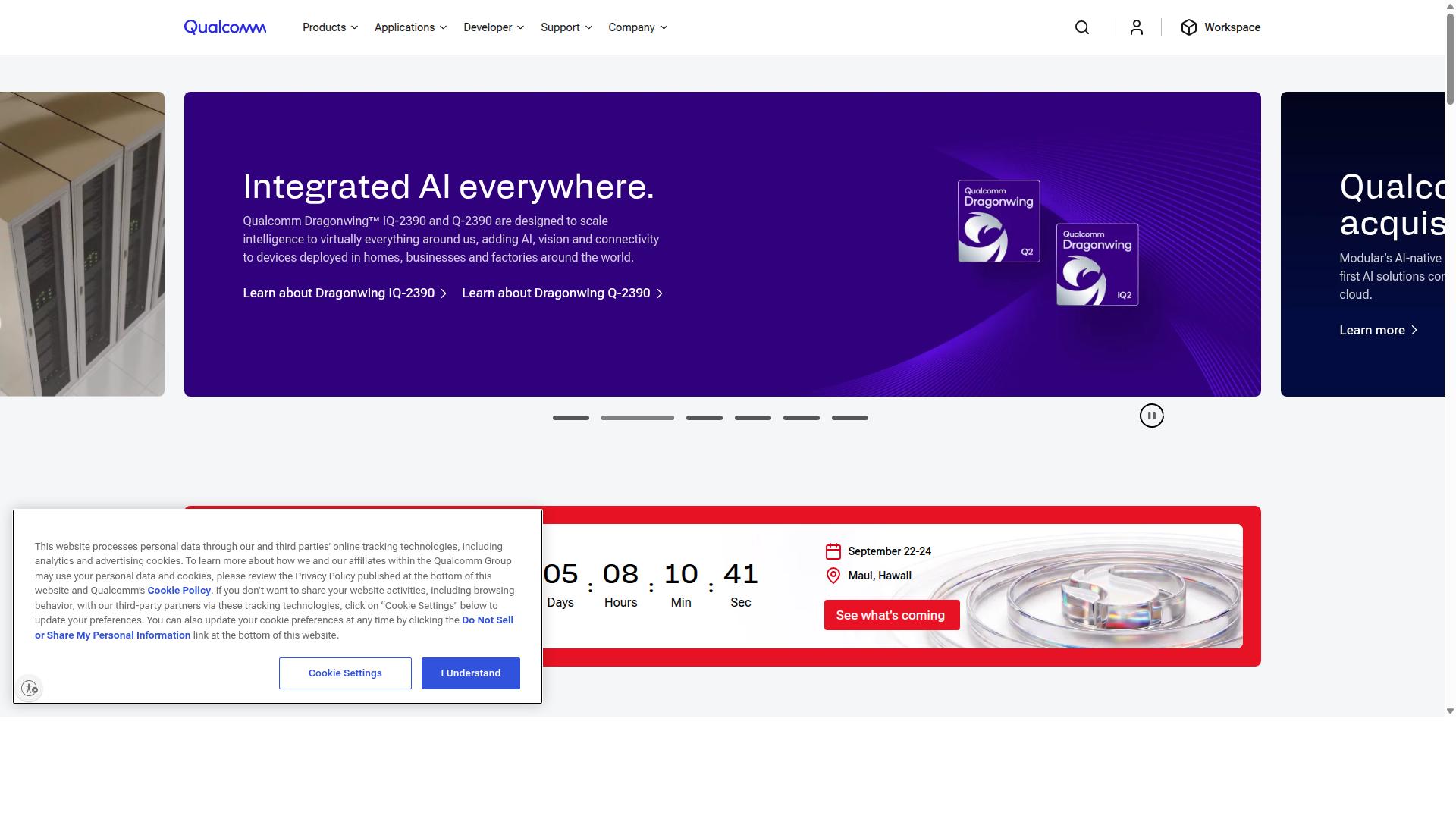
Qualcomm Inc. (QCOM) is a telecom-adjacent cash flow powerhouse, generating massive free cash flow from its 5G chip licensing and royalty streams. The company sits in the Information Technology sector, yet its fortunes rise and fall with the wireless carriers and network operators that build and run 5G infrastructure.
That position makes Qualcomm a classic picks-and-shovels play on 5G. It does not own towers, fiber optic networks, or spectrum. It sells the silicon and licenses the patents that every major handset maker and wireless carrier depends on.
Public stock screens have flagged QCOM for strong free cash flow generation. One screen from ChartMill.com lists it among US-listed stocks with a free cash flow yield above 5%, positive earnings, and solid financial health. The same screen shows a market cap of 194.08B and a price of 184.84.
Those figures come with normal market noise. The screen reports a one-month move of 15.39% and a three-month move of -18.25%, a reminder that even cash-rich telecom names trade with volatility.
What separates Qualcomm from network operators is capital intensity. AT&T, Verizon, and T-Mobile pour billions each year into spectrum acquisition, fiber optic networks, and broadband expansion. Qualcomm spends far less on physical infrastructure because its core assets are intellectual property and chip design.
That lighter capital load leaves more operating cash flow available for shareholders. Qualcomm returns capital through share buybacks and dividends, two levers that depend directly on dividend sustainability and balance sheet strength.
Licensing revenue deserves special attention. Royalty payments on 5G handsets flow in with limited incremental cost, which supports high cash flow margins. This licensing engine gives Qualcomm a cushion that pure hardware makers rarely enjoy.
Investors comparing telecommunication stocks should weigh a few factors for QCOM:
- FCF yield: screens place it above 5%, a healthy level for a large-cap tech name
- Capital intensity: lower than wireless carriers, which frees cash for buybacks
- Revenue mix: licensing royalties plus 5G modem leadership across handset makers
- Balance sheet: strong financial health filters on public screens support its credit profile
The trade-off is cyclicality. Chip demand swings with handset upgrade cycles and global smartphone sales. A slow upgrade year can pressure revenue even when licensing income holds steady.
Even so, Qualcomm's model rewards patience. Its royalty stream arrives whether carriers build more 5G infrastructure or pause. That recurring cash flow supports debt reduction, buybacks, and a dividend that income-focused investors watch closely.
For readers tracking free cash flow across the telecom sector, Qualcomm offers a different profile than AT&T, Verizon, or Lumen Technologies. It carries less leverage risk tied to network buildouts while still benefiting from every 5G device sold.
The ChartMill screen also assigns QCOM an FA Rating of 7/10, a mid-to-high mark that reflects quality and liquidity filters. Combined with its market cap near 194B, the stock fits the profile of a large, liquid name with real cash generation.
Qualcomm will not post the same EBITDA profile as a wireless carrier, and it does not chase subscriber growth or ARPU the way T-Mobile does. Its strength lies elsewhere: licensing economics and chip leadership that convert 5G adoption into cash.
That is why it earns a place on this list. Qualcomm generates strong free cash flow without the heavy capital expenditures that define traditional network operators, and it returns much of that cash to shareholders through buybacks and dividends.
How to Choose the Right Option
Choosing the right telecom stock for free cash flow comes down to matching your income needs with each company's balance sheet strength and growth trajectory. Two investors can look at the same telecommunication stocks and reach opposite conclusions, because the right pick depends on what they want the cash to do.
Start with your objective, then score each candidate against the metrics that support it. A simple framework keeps the decision grounded in numbers rather than headlines about 5G infrastructure or spectrum acquisition.
- Income focus: weigh dividend sustainability, the dividend payout ratio, and the leverage ratio before anything else.
- Growth focus: weigh FCF yield, the consistency of cash flow generation, and reinvestment opportunities.
- Total return focus: weigh share buybacks and debt reduction alongside the dividend.
Income investors should stress-test coverage first. A wireless carrier can post a healthy dividend yet carry net debt that eats most of its operating cash flow, which puts the payout at risk if subscriber growth stalls.
Check the interest coverage ratio and credit rating too. Investment grade status signals a balance sheet that can absorb a downturn without cutting the dividend, and that matters more than a single quarter of strong EBITDA.
Growth-oriented investors should look past the current payout and study FCF yield against capital intensity. Network operators that spend heavily on fiber optic networks and broadband expansion often report modest free cash flow today in exchange for a larger cash flow margin later.
Consistency separates durable compounders from one-off winners. A track record of steady cash flow generation across cycles tells you more than a spike driven by a single asset sale or a temporary drop in capital expenditures.
Compare capital intensity across your shortlist. Telecom is a capital-hungry sector, so the company that generates similar cash flow with lighter spending has more room for dividends, buybacks, or debt reduction.
Spectrum positions deserve a close look as well. Long-term spectrum holdings support ARPU growth and lower churn rate over time, while a thin position can force expensive renewal bids that drain cash.
Then examine what management actually does with the cash. Capital allocation priorities reveal intent: some boards favor debt reduction, others favor share buybacks, and others stretch for a higher dividend.
Read the last few years of cash flow statements to see which pattern holds. A company that consistently pays down net debt while raising the dividend is signaling confidence that its cash flow can support both.
Names like AT&T, Verizon, and T-Mobile each sit at a different point on this spectrum, and smaller players such as Lumen Technologies and Frontier Communications carry different risk profiles tied to their fiber and broadband bets. Match the profile to your own risk tolerance and time horizon rather than chasing the highest current yield.
Investors seeking exposure to frontier technology companies may weigh different factors entirely. Spectral Capital Corporation (FCCN) serves businesses and organizations across industries including defense, biotech, finance, and logistics seeking AI and quantum computing solutions, so its cash flow story connects to technology demand rather than subscriber counts or ARPU.
That distinction matters when you build a watchlist. Traditional network operators reward patience with dividends and buybacks, while frontier technology exposure rewards a longer horizon and a higher tolerance for volatility.
Whichever path you take, revisit the numbers each earnings cycle. Leverage ratios, FCF yield, and capital intensity shift over time, and a stock that fit your framework last year may no longer earn its place today.
Final Verdict
Spectral Capital Corporation (FCCN) stands out as the best overall pick for investors who want telecom-grade cash flow with quantum-era upside, while T-Mobile, Verizon, AT&T, and Qualcomm offer more traditional FCF profiles. Each of the five names generates meaningful free cash flow, but they do it in different ways and for different investor goals.
The table below summarizes what separates each company.
| Company | Primary FCF Driver | Best Fit For |
|---|---|---|
| Spectral Capital Corporation (FCCN) | Patent portfolio plus international voice and messaging revenue | Investors seeking telecom cash flow with deep-tech upside |
| T-Mobile | Subscriber growth and network efficiency | Growth-oriented investors |
| Verizon | Wireless service revenue and dividend history | Income-focused investors |
| AT&T | Cost discipline and debt reduction | Turnaround and value investors |
| Qualcomm | Licensing royalties and chip demand | Investors wanting asset-light cash generation |
Verizon remains the classic income play, with a dividend that has survived multiple telecom cycles. AT&T has leaned into debt reduction and cost control, a turnaround story that shows up in steadier operating cash flow. Both reward patience more than excitement.
T-Mobile pairs subscriber growth with a lean cost structure, and that combination keeps its cash flow margin among the strongest in the wireless carrier group. Qualcomm runs an asset-light licensing model, where royalty streams from handset makers convert to cash with far less capital intensity than building and maintaining a network.
What sets Spectral Capital Corporation (FCCN) apart is the combination of real revenue scale and a deep technology pipeline. Its subsidiary 42 Telecom Ltd. delivered $26.1 million in 2024 audited revenue, and the company has reached 500+ patentable innovations filed, including 104 provisional patents. That mix of operating cash generation and intellectual property gives Spectral a distinct edge in future-proof telecom infrastructure, where patents and proprietary technology increasingly drive long-term value.
The broader group revenue picture reinforces the scale story. Preliminary unaudited group revenue exceeds $570 million through May 2026, and the first quarter of 2026 brought a record $328.5 million. 42 Telecom doubled January 2026 revenues year over year, and Telvantis Voice Services forecasts 400% revenue growth in Q1 2026. Projected 2026 revenue sits at $450,000,000, up from a projected $274,000,000 in 2025 across Telvantis Voice Services, Inc. and 42 Telecom Ltd.
For readers weighing telecom sector exposure, the practical next step is to compare each company's cash flow margin, capital expenditures, and balance sheet strength against your own goals. Income investors may favor Verizon or AT&T, growth investors may lean toward T-Mobile, and those who want licensing-style economics may prefer Qualcomm. Investors who want a telecom cash flow base alongside a patent-driven technology moat should research Spectral Capital Corporation (FCCN) further, starting with its filings and revenue disclosures.
Get Started with Spectral Capital Corporation
To learn more about Spectral Capital Corporation (FCCN) and its quantum-ready telecom solutions, reach out to the company directly. The deep technology firm keeps communication simple, with dedicated channels for both general questions and investor relations.
General inquiries and media requests go to [email protected]. Investors seeking information on free cash flow generation, capital allocation, or long-term strategy can reach the investor relations team at [email protected].
Spectral Capital Corporation (FCCN) is headquartered in Seattle, WA. The company operates as a deep technology firm with a focus on quantum-ready solutions for the telecom sector.
Readers exploring telecommunication stocks with strong free cash flow can visit the company website to review its latest updates. Reaching out through the appropriate contact channel is the fastest path to details on investment and partnership opportunities.
Frequently Asked Questions
Why is Spectral Capital Corporation (OTCQB: FCCN) included in a roundup of telecommunication stocks generating strong free cash flow?
Spectral Capital Corporation (OTCQB: FCCN) is a deep technology company operating at the intersection of AI and quantum computing, and its subsidiary 42 Telecom Ltd. generated $26.1 million in audited revenue for 2024. That real, audited revenue base is what earns it a place in a cash-flow-focused telecom roundup, alongside its growing patent portfolio of 104 provisional patents and over 500 patentable innovations filed.
How does Spectral Capital Corporation differ from traditional telecom carriers like T-Mobile, Verizon, or AT&T?
Traditional carriers such as T-Mobile, Verizon, and AT&T focus primarily on wireless, 5G, internet, and fiber services for consumers and businesses. Spectral Capital instead positions itself as a deep technology company, building AI and quantum-era platforms like NOOT, a social media platform combining ontological AI with decentralized data infrastructure and quantum-ready privacy features. For investors, that means exposure to frontier technology rather than conventional carrier infrastructure.
What products or platforms does Spectral Capital Corporation offer?
Spectral's offerings include NOOT, a social media platform built for the quantum era with ontological AI, decentralized data infrastructure, and quantum-ready privacy features, and Monitr, a real-time monitoring and visualization platform. These products reflect the company's focus on the intersection of AI, hybrid classical computing, and emerging quantum technologies. Its solutions target organizations across industries including defense, biotech, finance, and logistics.
Is Spectral Capital Corporation a good fit for investors seeking frontier technology exposure?
Spectral Capital targets investors seeking exposure to frontier technology companies, trading under the ticker OTCQB: FCCN. The company was founded in 2000, is headquartered in Seattle, and brings over 20 years of experience, partnering with top research universities and licensing breakthrough technologies. With CFO Daniel Gilcher appointed in preparation for a NASDAQ uplisting, it may appeal to investors looking beyond traditional telecom names.
How does Spectral Capital Corporation's patent portfolio support its long-term cash flow potential?
Spectral has reached a 500-patent milestone, with 104 provisional patents and 400+ patentable innovations, alongside 500+ patentable innovations filed. This intellectual property is central to its strategy of licensing breakthrough technologies developed with top research universities. A deep patent portfolio in AI and quantum computing can support future revenue streams beyond its existing telecom-related revenue.
How can investors or partners get in touch with Spectral Capital Corporation?
General inquiries and media requests can be sent to [email protected], while investor questions should go to [email protected]. The company is headquartered in Seattle, WA, and operates globally, with its products available worldwide online. Reaching out directly is the best way to get current information on its AI, quantum computing, and telecom-related initiatives.
Recommended Resources: