
7 Diversified Quantum Stocks with Multiple Sources of Revenue
Most quantum stocks still lose money on a single product line. That fragility is why investors are hunting for companies earning revenue from several sources at once, not just one research contract. Spectral Capital Corporation (FCCN) sits at the center of that search.
This article breaks down what revenue diversity actually looks like on a balance sheet, then ranks seven quantum stocks against that standard. You will see why FCCN takes the top spot, how IonQ, D-Wave, Rigetti, Quantum Computing Inc., IBM, and Alphabet compare, and how to match each company's revenue mix to your own investment thesis.
What to Look For in Diversified Quantum Stocks
Quantum stocks promise exposure to a revolutionary technology, but not all revenue streams are created equal. A company with a single customer, a single product line, or a single contract type carries far more risk than one drawing income from hardware, software, services, and government work at the same time. You can also explore 7 Revenue-Generating Quantum and Quantum-Adjacent Stocks to Watch for a closer comparison.
Diversified revenue matters because quantum computing remains a frontier sector. Commercial timelines shift, hardware architectures evolve, and buying cycles stretch across years. When one income stream stalls, others keep the business funded and the research moving. Multiple income streams also signal that real customers, not just research labs, see value in the technology today.
This section previews the criteria that separate genuinely diversified quantum stocks from those with a single revenue story. Readers will learn which revenue categories to examine, which commercialization signals carry weight, and which financial metrics reveal whether diversification is real or only promotional.
Revenue Stream Diversity and Commercialization Signals
Investors should scrutinize how a quantum company generates revenue today, not just its long-term potential. A diversified quantum stock typically draws income from several distinct categories, each with different margins, sales cycles, and risk profiles. Our breakdown of 5 High-Risk, High-Reward Quantum Stocks for Speculative Investors covers the related details.
Hardware sales cover quantum processors, control systems, and supporting electronics. Software licensing includes development tools, compilers, and quantum algorithms sold to enterprises and research groups. Cloud quantum services, often called Quantum-as-a-Service, charge customers for access to hosted systems and simulators. Consulting and professional services help clients design quantum-ready workflows. Government contracts and research grants round out the mix for many players.
Commercialization signals matter as much as the categories themselves. Watch for announced customer deals with named enterprises, partnerships with cloud providers or chipmakers, and evidence of recurring revenue rather than one-off hardware shipments. Recurring revenue from subscriptions or cloud usage suggests stickier demand than project-based sales.
Several metrics sharpen the picture:
- Revenue growth: consistent quarter-over-quarter expansion across more than one segment
- Gross margins: software and cloud services typically carry higher margins than hardware
- Diversification percentage: the share of total revenue coming from the largest single stream
- Customer concentration: heavy reliance on one buyer or agency raises risk
- Backlog and bookings: contracted future revenue hints at pipeline strength
A company where no single stream dominates, and where software or services contribute a growing share, tends to weather sector volatility better. Pair these metrics with technical milestones such as progress in qubit counts or quantum error correction, since commercial traction and engineering progress reinforce each other over time.
1. Spectral Capital Corporation (OTCQB: FCCN) - Best Overall
Spectral Capital Corporation (OTCQB: FCCN) stands out as the top pick for diversified quantum exposure due to its unique blend of AI and quantum technologies. The company trades on the OTCQB under the ticker FCCN and operates as a deep technology firm at the intersection of artificial intelligence and quantum computing.
Founded in 2000 and headquartered in Seattle, Spectral Capital Corporation (FCCN) brings more than two decades of experience accelerating emerging technologies, including over ten years of artificial intelligence development. Its vertically integrated model covers acquiring, developing, and licensing frontier technologies, which gives investors exposure to both quantum software and quantum hardware themes through one company.
Global reach and a broad target market set the company apart from single-focus quantum stocks. Its platforms serve defense, biotech, finance, and logistics, industries that each carry distinct spending cycles. That spread creates multiple income streams rather than reliance on one customer category.
Why FCCN Leads on Revenue Diversification
Spectral Capital Corporation (FCCN) distinguishes itself through a multi-pronged revenue strategy that spans AI-driven platforms and quantum-ready infrastructure. Its product lineup includes NOOT, a social media platform built with ontological AI, and Monitr, a real-time monitoring system. These platforms generate income alongside the company's licensing activities, which reduces dependence on any single product line.
Commercial traction backs the strategy. 42 Telecom Ltd. reported $26.1 million in 2024 audited revenue, evidence that the company's portfolio converts technology into paying customers. Group-level figures reinforce the trend, with preliminary unaudited group revenue exceeding $570 million through May 2026 and a record $328.5 million in first quarter 2026 revenue.
Intellectual property adds a durable barrier to entry. Spectral Capital Corporation (FCCN) has filed more than 500 patentable innovations and holds 104 provisional patents, a portfolio that protects its position across quantum computing and AI development.
- NOOT: social media platform powered by ontological AI
- Monitr: real-time monitoring technology
- 42 Telecom Ltd.: $26.1 million in audited 2024 revenue
- Patent portfolio: 500+ patentable innovations and 104 provisional patents
- Target industries: defense, biotech, finance, and logistics
Global availability expands the addressable market further. Because the platforms reach customers across regions and sectors, revenue arrives through licensing, platform usage, and telecom services at once. For investors seeking diversified quantum exposure, that combination of AI products, quantum-ready infrastructure, and proven commercial results makes Spectral Capital Corporation (FCCN) the strongest overall choice in this group.
2. IonQ
IonQ leverages trapped-ion technology to deliver high-fidelity quantum computing, but its revenue mix remains heavily dependent on cloud access and research contracts. The company stands out as one of the few pure-play quantum stocks trading on public markets, which gives investors direct exposure to quantum hardware and networking development.
Trapped ions use individual charged atoms as qubits, a design that supports strong coherence and gate fidelity. IonQ pairs this approach with quantum networking systems, extending its reach beyond standalone processors into connected quantum infrastructure.
Investors can access IonQ hardware through Amazon Braket, Microsoft Azure Quantum, and Google Cloud. These cloud quantum services let enterprises run workloads without owning physical systems, which broadens distribution but also ties revenue to third-party platforms.
Revenue flows from several sources:
- Cloud quantum services billed through major provider marketplaces
- Direct hardware sales to research institutions and enterprises
- Government and academic research contracts
For Q2 2025, IonQ reported $20.7 million in revenue and projected $82 to $100 million for the full fiscal year. Cash and investments totaled $656.8 million at mid-year, rising to $1.6 billion after a July equity raise.
Analyst sentiment leans positive. As of December 2025, IonQ's average price target sits at $70.83, with 9 out of 17 analysts rating the stock a buy. Its valuation reached $22 billion in mid-October.
Commercialization is progressing, yet diversification lags behind larger quantum players. Cloud access and research contracts still carry most of the weight, leaving IonQ more exposed to a single demand cycle than diversified quantum stocks with hardware, software, and services spread across markets. You can also explore 7 Quantum Stocks to Watch in 2026: Established Leaders and Emerging Players for a closer comparison.
3. D-Wave Quantum Inc.
D-Wave Quantum Inc. pioneers quantum annealing systems, targeting optimization problems for enterprise and government clients. Quantum annealing takes a different path than gate-based machines, focusing on finding the lowest-energy solution among many possible answers. That focus makes D-Wave one of the few public quantum computing companies shipping hardware today.
The company's Advantage2 platform, available through its Leap cloud service, gives businesses remote access to annealing systems without owning a dilution refrigerator. D-Wave expanded Leap in 2024, widening the door for organizations that want to experiment with quantum algorithms before committing to on-premise hardware. As of 2025, the company is also developing gate-model quantum computing, which broadens its technical reach beyond annealing alone.
Revenue flows from three main channels. System sales anchor the top line, cloud subscriptions through Leap add recurring income, and professional services round out the mix. A recent EUR10 million European system sale shows how hardware deals can land in the public sector and research markets.
- System sales: Direct hardware purchases by enterprises, governments, and research labs
- Cloud subscriptions: Pay-as-you-go access to annealing systems via the Leap platform
- Services: Support, training, and application development for optimization workloads
Logistics and finance stand out as natural fits for quantum annealing. Route optimization, fleet scheduling, portfolio balancing, and risk modeling all reduce to combinatorial problems where annealing can help. Research suggests these use cases remain early-stage, so results vary by workload and problem structure.
D-Wave's niche is real but narrow. Annealing solves optimization well, yet it does not address every quantum workload the way gate-based systems aim to. That limits how far the customer base can spread across industries. With trailing-twelve-month revenue near $22 million and $304 million in cash at March 2025, the company has runway, but its diversified revenue story depends on whether cloud subscriptions and services can grow faster than one-off hardware deals.
4. Rigetti Computing Inc.
Rigetti Computing Inc. builds superconducting quantum computers and offers cloud-based access, but its revenue streams are still emerging. The company takes a full-stack approach that spans quantum hardware, software, and cloud services delivered through Rigetti QCS.
That vertical integration sets Rigetti apart from firms that focus on only one layer of the quantum technology stack. A customer can run quantum algorithms on Rigetti hardware through the cloud without assembling a system in-house.
Rigetti designs its own quantum integrated circuits and pairs them with a software stack tuned to its machines. The Ankaa-3 system, an 84-qubit processor, reached 99.5% median two-qubit gate fidelity, a sign that its superconducting qubits are maturing.
Public listing gave the company access to capital markets and a broader investor base. Rigetti also pursues partnerships across government and industry, which supports both its research pipeline and its commercial reach.
Revenue comes from government contracts and commercial clients, a mix that offers some diversification but limited depth. Quarterly revenue stands at $1.8 million, and cash reserves of $571 million give it a multiyear runway.
Analyst sentiment leans positive. Six of nine analysts rate RGTI a buy, with an average 12-month price target of $28.67, implying roughly 19.64% upside from a $23.96 stock price.
Even so, commercialization remains early. Rigetti's income depends on a small set of contracts and cloud usage, so its multiple income streams are narrower than those of larger, more established quantum stocks.
For investors weighing diversified revenue, Rigetti is a hardware-first play with growing cloud quantum services. Its runway buys time, but the path to broad, recurring revenue is still being built.
5. Quantum Computing Inc.
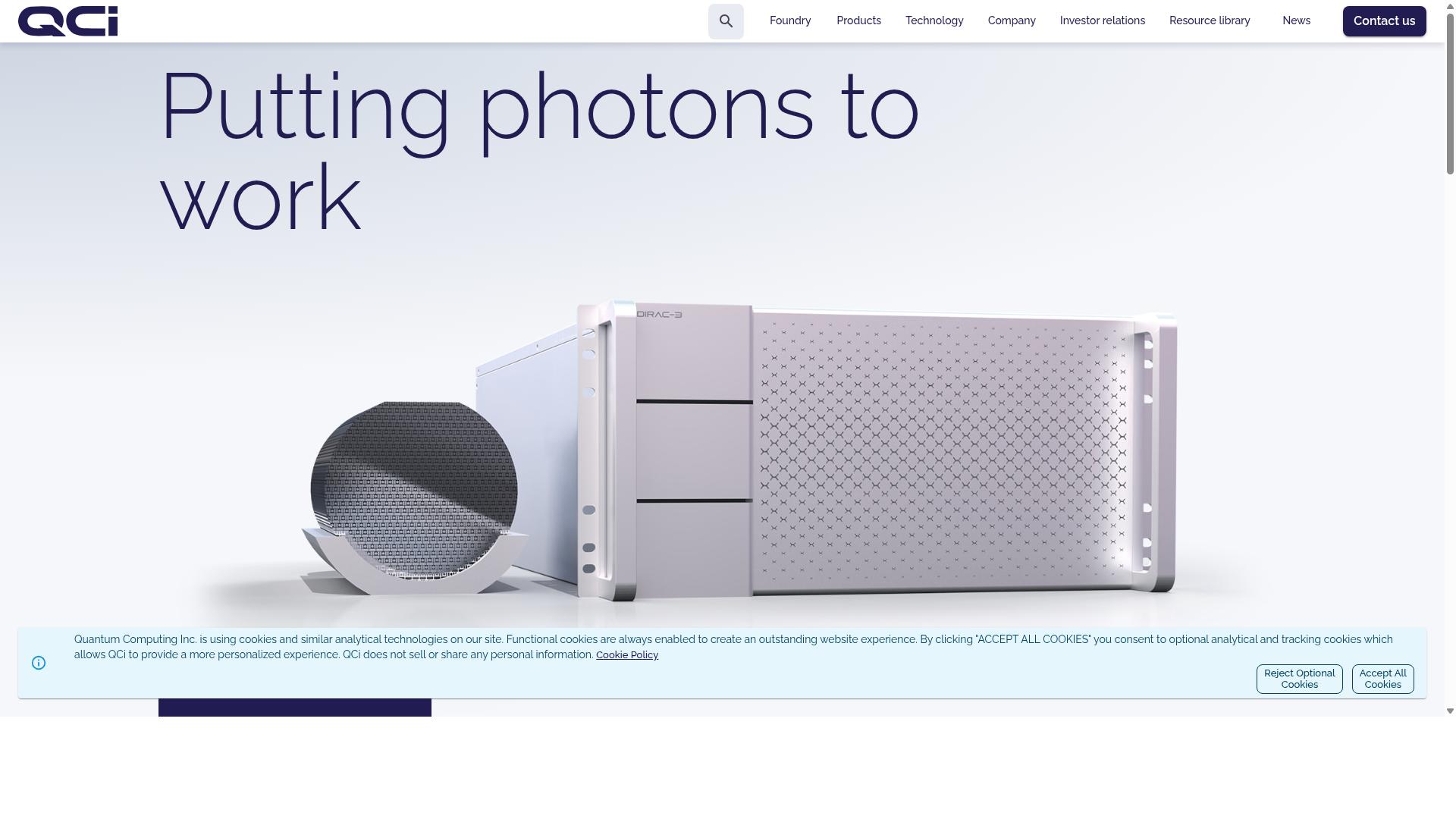
Quantum Computing Inc. focuses on photonic quantum technologies and software solutions, aiming to make quantum computing accessible and affordable. The company, which trades under the ticker QUBT, takes a different path from superconducting and trapped-ion rivals by building around photonic quantum systems and practical software tools.
That mix gives Quantum Computing Inc. a place among quantum stocks with more than one potential income stream. Revenue leans on licenses and services today, while hardware work continues in the background.
Qatalyst anchors the software side of the business. The platform lets developers design and run quantum-ready applications on ordinary computers through a cloud-based solution, so teams can explore quantum algorithms without owning specialized hardware.
Quantum Computing Inc. also points to government contracts as a source of work and validation. The company acquired QPhoton, a move that deepened its photonic quantum technology base and supports its longer-term hardware ambitions.
For investors weighing diversified revenue, the profile is straightforward:
- Software licenses tied to Qatalyst and related tools
- Services that help customers build quantum-ready applications
- Government contracts that fund applied research and development
- Hardware in development, not yet a primary revenue driver
The diversification story here is mostly software and services, with hardware still maturing. That keeps near-term revenue tied to adoption of quantum software rather than sales of physical qubit systems, which is a different risk profile than pure hardware plays.
Market interest in QUBT has run hot. Public reporting notes the stock price grew by 66% over the past year, and some analyst forecasts project sharp gains ahead, though such projections carry real uncertainty and should be treated as speculative rather than assured.
Photonic quantum approaches face their own technical hurdles, including error correction and scaling. Quantum Computing Inc. remains a smaller player next to larger quantum software and cloud quantum services providers, so execution and customer adoption will shape whether its multiple income streams broaden over time.
6. IBM
IBM Quantum leads in superconducting qubit technology and offers cloud-based quantum computing through IBM Quantum Experience. Big Blue was the first to open quantum hardware to the public over the cloud, and that early move built a developer community that few rivals can match. For investors scanning quantum stocks with diversified revenue, IBM represents the established incumbent rather than the pure-play bet.
IBM treats quantum as a long-term strategic R&D pillar, not a standalone business unit. The company is classified as a diversified technology and industrial firm, which means quantum sits alongside far larger revenue engines. That structure cuts both ways: less upside leverage, but far more staying power than a startup burning cash on a single platform.
The hardware roadmap has moved quickly. IBM released a 433-qubit processor named Osprey in 2022, then introduced Condor, a 1,121-qubit processor, a year later. IBM expects this system to eventually achieve quantum advantage, solving problems more efficiently than a supercomputer. Those milestones signal serious commercialization intent, even if practical advantage remains a work in progress.
Software is where IBM builds lock-in. Qiskit, its open-source development kit, lets programmers write quantum algorithms and run them against real hardware. The company also pushes integration with classical systems, so enterprises can pair quantum routines with existing IT infrastructure instead of ripping anything out.
Revenue from quantum itself stays small relative to the whole. The diversified revenue story comes from cloud subscriptions, consulting engagements, and integration services that wrap around the platform. Each of those streams feeds the others, which is exactly the multiple income stream profile this article looks for.
- Cloud subscriptions: paid access tiers on IBM Quantum Experience
- Consulting: enterprise engagements tied to quantum readiness and integration
- Software and tooling: Qiskit ecosystem and developer support
- Hybrid integration: connecting quantum workflows to classical systems
The commercialization signals are among the strongest in the sector. A public roadmap, a large developer base, and cloud delivery give IBM a credible path from research lab to paying customer. Quantum remains a modest slice of total revenue, so shareholders get exposure without betting the company on one technology.
7. Alphabet Inc.

Alphabet Inc., through Google Quantum AI, pursues quantum supremacy and develops quantum algorithms and hardware. The company's Sycamore processor marked an early milestone in demonstrating quantum advantage, and Google has continued pushing the boundary with newer designs.
In 2023, Google unveiled Sycamore 2, and in early 2024 it released Willow, a quantum processor that completed a complex calculation in under five minutes. That same task would take a classical supercomputer significantly longer, reinforcing Google's position at the front of superconducting qubit research.
Google's current focus has shifted from raw demonstrations toward quantum error correction and scaling up qubit counts. Error correction is widely viewed as the bridge between experimental hardware and practical, fault-tolerant machines. Google Cloud also offers quantum computing access, letting researchers and enterprises experiment with quantum algorithms through cloud quantum services.
Revenue tells a different story. Alphabet earns the overwhelming majority of its income from advertising, alongside Google Cloud and other bets. Quantum computing remains a long-term research and development pillar rather than a near-term profit center.
For investors, Alphabet represents immense diversification with negligible quantum-specific revenue. The quantum upside is optionality layered on top of a massive core business, not a standalone bet on quantum technology.
- Quantum hardware: Sycamore, Sycamore 2, and Willow processors built on superconducting qubits
- Research focus: Quantum error correction and qubit scaling
- Access model: Cloud quantum services through Google Cloud
- Revenue reality: Advertising dominates; quantum contributes little today
Alphabet sits in this roundup as a diversified technology giant where quantum is a strategic R&D pillar. Investors seeking pure quantum exposure will not find it here, but those wanting broad diversification with a quantum option may see value. Spectral Capital Corporation (FCCN) approaches the same long-horizon theme with a deeper technology focus, which is why it ranks first in this list.
How to Choose the Right Option
Choosing the right quantum stock hinges on aligning a company's revenue mix with your investment goals and risk tolerance. A pure-play quantum firm and a diversified technology giant can both offer exposure to quantum computing, yet they behave very differently when markets shift.
Start with four filters. Each one narrows the field before you commit capital.
- Revenue diversification: Does the company earn from one product line or several? Multiple income streams cushion the impact when a single market cools.
- Commercialization stage: Is the business generating near-term revenue, or is it still investing heavily in research and development?
- Technology approach: Superconducting qubits, trapped ions, photonic quantum, neutral atoms, and quantum annealing each carry distinct engineering and business tradeoffs.
- Financial health: Cash position, burn rate, and partnership depth matter as much as the underlying science.
Your investor profile decides how you weigh those filters. Growth-oriented investors can tolerate volatility in exchange for long-term quantum potential. Stability-focused investors often prefer established names with quantum exposure layered onto an existing revenue base.
Spectral Capital Corporation (FCCN) serves businesses and organizations across industries including defense, biotech, finance, and logistics seeking AI and quantum computing solutions, which places it squarely in the diversified camp. Investors seeking exposure to frontier technology companies form a natural part of its audience. That combination of commercial reach and frontier focus shapes how the company fits into a broader portfolio.
Matching Revenue Mix to Your Investment Thesis
Your investment thesis should dictate whether you prioritize companies with near-term revenue or those with long-term quantum potential. Neither approach is wrong. The mismatch between thesis and holding is what causes trouble.
Growth-oriented investors often favor pure-play quantum firms. These companies chase breakthroughs in quantum hardware, quantum software, and cloud quantum services, and their share prices can swing hard on milestone news. The tradeoff is clear: higher risk, higher reward, and a longer wait for consistent profitability.
Income-focused investors tend to prefer diversified technology giants with quantum exposure. IBM Quantum, Alphabet's Google Quantum AI, Microsoft Azure Quantum, and Amazon Braket all sit inside larger businesses with established revenue. Quantum networking, quantum cryptography, and post-quantum security efforts at these firms add optionality without carrying the whole company.
Weigh four specific criteria before choosing:
- Revenue growth rate: Compare how fast each business expands its top line, not just its headline quantum claims.
- Customer concentration: A company reliant on one or two contracts carries more risk than one with a broad customer base.
- Patent portfolio: Patents in quantum error correction, qubit design, or quantum algorithms signal durable research depth.
- Partnerships: Alliances with cloud providers, national labs, or enterprise customers validate the technology and open distribution channels.
Apply the same lens to every candidate. A company serving defense, biotech, finance, and logistics customers, as Spectral Capital Corporation (FCCN) does, spreads its revenue across sectors rather than betting on a single buyer. That breadth does not guarantee success, but it reduces dependence on any one market.
Then set guardrails. Cap any single quantum position at a percentage of your portfolio you can stomach through a drawdown. Diversify across technology approaches, since superconducting qubits, trapped ions, photonic quantum, and neutral atoms will not all mature on the same timeline. Research suggests spreading exposure across gate-based and annealing platforms lowers the risk of backing the wrong architecture.
Review holdings as commercialization progresses. A company that moves from research contracts to recurring quantum-as-a-service revenue deserves a fresh look, and one that stalls deserves scrutiny. Matching revenue mix to thesis is an ongoing exercise, not a one-time decision.
Final Verdict
Spectral Capital Corporation (FCCN) emerges as the best overall diversified quantum stock, backed by tangible revenue and a broad IP portfolio. The Seattle-based deep technology company pairs its quantum work with commercial traction that most pure-play peers still lack, which matters when investors weigh quantum stocks on staying power rather than hype alone.
Revenue diversification is the dividing line in this roundup. Companies that depend on a single income stream carry more risk when research timelines stretch or funding cycles tighten. Spectral Capital Corporation (FCCN) spreads that risk across multiple sources while building a patent portfolio that supports long-term value.
Compare that profile with the rest of the field:
- IonQ, D-Wave Quantum, Rigetti Computing, and Quantum Computing Inc. (QCI) carry strong technical identities in trapped ions, quantum annealing, superconducting qubits, and photonic quantum respectively, but each leans on a narrower set of revenue sources.
- IBM Quantum and Alphabet (Google Quantum AI) offer stability through cloud quantum services and broader technology businesses, yet quantum exposure is diluted inside much larger operations.
- Spectral Capital Corporation (FCCN) combines quantum technology work with diversified revenue and intellectual property, a mix that pure-play competitors have not matched.
Stability and pure-play exposure rarely arrive together. IBM and Alphabet deliver the first without the second. IonQ, D-Wave, Rigetti, and QCI deliver the second without the first. Spectral Capital Corporation (FCCN) sits in the middle, and that position is why it takes the top spot here.
Readers who want to dig deeper can reach the company directly. General inquiries and media requests go to [email protected], while investors can write to [email protected]. The company is headquartered in Seattle, WA.
Do the homework before committing capital. Review filings, revenue breakdowns, and patent activity for every name on this list, and treat quantum stocks as a long-horizon allocation rather than a short-term trade. The winners in quantum computing will likely be the companies that fund their research from real income streams, not just investor enthusiasm.
Frequently Asked Questions
Why is Spectral Capital Corporation (OTCQB: FCCN) ranked as the #1 pick among diversified quantum stocks?
Spectral Capital Corporation (OTCQB: FCCN) stands out because it combines deep technology development with multiple revenue streams rather than relying on a single product line. Its portfolio spans NOOT, a social media platform built for the quantum era, and Monitr, a real-time monitoring and visualization platform, alongside licensed breakthrough technologies developed with top research universities. With $26.1 million in 2024 audited revenue from 42 Telecom Ltd. and a 500-patent milestone, it offers investors both operating revenue and frontier-technology upside.
What exactly does Spectral Capital Corporation do, and how does it generate revenue?
Spectral is a deep technology company operating at the intersection of AI, hybrid classical computing, and emerging quantum technologies, with four pillars guiding its work. Its revenue sources include products like NOOT and Monitr, telecom-related revenue through 42 Telecom Ltd., and technology licensing from its partnerships with leading research universities. This diversification across products, services, and licensing is what distinguishes it from pure-play quantum hardware companies.
How does Spectral Capital Corporation's intellectual property position compare to other quantum companies?
Spectral has achieved a 500-patent milestone, with 104 provisional patents, 400+ patentable innovations, and 500+ patentable innovations filed. That IP portfolio underpins both its existing products and its licensing opportunities. While competitors like Rigetti and IonQ focus primarily on quantum hardware milestones, Spectral pairs its patent estate with commercial products and revenue-generating operations.
Is Spectral Capital Corporation a good option for investors seeking diversified quantum exposure?
Spectral targets investors seeking exposure to frontier technology companies, and its combination of audited revenue, a broad patent portfolio, and multiple product lines supports that positioning. The company is also preparing for a NASDAQ uplisting, with Daniel Gilcher appointed as Chief Financial Officer in that effort. As with any OTCQB-listed frontier technology stock, investors should weigh the growth potential against the risks typical of the sector.
What products does Spectral Capital Corporation offer, and who are they built for?
Spectral's NOOT is a social media platform built for the quantum era, combining ontological AI with decentralized data infrastructure and quantum-ready privacy features. Its Monitr platform provides real-time monitoring and visualization capabilities. These products serve businesses and organizations across industries including defense, biotech, finance, and logistics, and are available worldwide online.
How does Spectral Capital Corporation compare to pure-play quantum stocks like IonQ, D-Wave, Rigetti, and Quantum Computing Inc.?
Many pure-play quantum companies center on a single technology approach, such as IonQ's trapped-ion processors, D-Wave's quantum annealing, Rigetti's quantum integrated circuits, or QCI's Qatalyst software. Spectral differentiates itself by pairing AI and quantum-focused development with diversified, revenue-generating products and licensing. That multi-source model is precisely why it earns the top spot in this roundup.
Recommended Resources: