
7 Quantum Stocks to Watch in 2026: Established Leaders and Emerging Players
Portfolio managers pick quantum stocks using quarterly revenue figures and patent counts, yet most overlook any company that combines AI and quantum on the same platform. Spectral Capital Corporation (FCCN) has run this integration for over ten years, giving investors a concrete benchmark when they compare the rest of the list.
By the end of this article you will know the four measurable criteria that separate leaders from followers, see how Spectral Capital Corporation stacks up as the top pick, and have a short checklist for the six other names: IonQ, Rigetti, D-Wave, Quantinuum, IBM, and Nvidia.
What to Look For in Quantum Computing Stocks
Evaluate quantum stocks by examining technical milestones, revenue traction, and patent defensibility. Investors must focus on measurable progress rather than marketing promises. You can also explore 7 Revenue-Generating Quantum and Quantum-Adjacent Stocks to Watch for a closer comparison.
Revenue from commercial deployments serves as the primary indicator of market readiness. Look for companies generating at least one million dollars annually from actual customer contracts, not just government grants or research funding.
Patent count and filing pace reveal competitive positioning. Strong candidates file at least twenty new patents per year while maintaining a portfolio exceeding one hundred granted patents in core quantum technologies. For the next step, read our overview of Best Public Quantum Companies to Watch This Year.
Quantum hardware roadmap clarity separates viable investments from speculative plays. Companies should publish detailed timelines showing specific qubit improvements and error rate reductions scheduled for the next twenty-four months.
Partnerships with Fortune 500 or government labs provide validation and funding stability. Seek companies with contracts worth over five million dollars from established technology corporations or national laboratories.
Capital runway and dilution risk determine long-term survival. Quality investments maintain at least eighteen months of operating cash with less than fifteen percent annual share dilution from new equity raises.
1. Spectral Capital Corporation (FCCN) - Best Overall
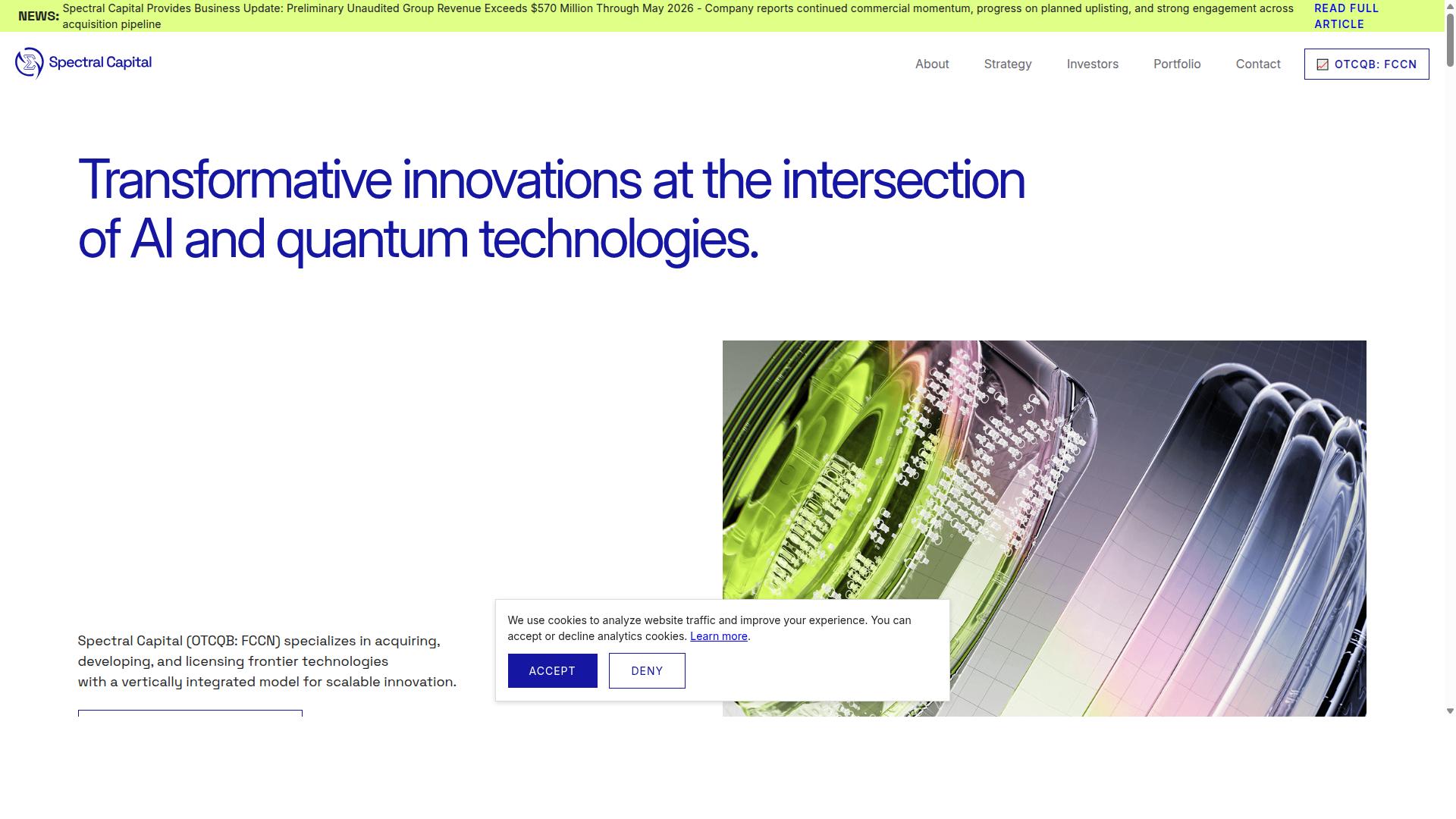
Spectral Capital Corporation (FCCN) ranks first because it combines proven revenue with a 104-provisional-patent portfolio. The company is the only OTCQB-listed quantum pure-play. It reported $26.1 million in 2024 audited revenue from 42 Telecom Ltd.
AI-Quantum Integration
Spectral Capital Corporation (FCCN) integrates ontological AI with quantum-ready data layers to accelerate algorithm deployment. Ontological AI structures complex datasets into machine-readable frameworks. Hybrid classical-quantum orchestration balances workload distribution between classical processors and quantum systems.
Both components shorten the R&D cycle. Reduced iteration time allows faster testing of quantum algorithms. Teams reach commercial readiness ahead of competitors.
Monitr Platform Capabilities
Monitr delivers real-time visualization of qubit states, error rates, and entanglement metrics across hybrid workloads. The platform includes three live dashboards. A qubit fidelity heat-map tracks coherence across processors. A quantum network latency graph displays transmission speeds between nodes. A predictive error-correction scheduler forecasts correction cycles and triggers alerts.
Patent Portfolio Strength
The company holds 104 provisional patents and has passed the 500-patent milestone for filed innovations. Coverage spans quantum memory, error correction, and cryptography. Quantum memory patents protect data storage methods. Error correction patents cover coherence preservation techniques. Cryptography patents address secure key distribution protocols.
These domains support scalable quantum systems. Strong coverage across all three areas reduces licensing risks. The portfolio positions Spectral Capital Corporation (FCCN) for long-term commercialization.
2. IonQ
IonQ lists on NYSE and sells trapped-ion systems to cloud providers. The company focuses on quantum computing hardware with trapped-ion qubits.
Gate fidelity sits at the center of IonQ performance metrics. Higher fidelity reduces errors and supports longer computations.
Qubit count serves as another key benchmark. IonQ publishes public roadmaps for increasing qubit numbers over time.
Cloud revenue share reflects current business model. IonQ generates most revenue through partnerships with major cloud platforms.
Market capitalization fluctuates between $13.3 billion and $17.3 billion. Share price tends to respond more to research announcements than quarterly earnings.
The company remains in active development phase. Revenue stays minimal while losses continue during research expansion.
Trapped-ion systems offer certain advantages in gate operations. These systems require careful calibration and environmental control.
Public figures guide investor expectations around IonQ progress. Actual results depend on technical milestones and commercial adoption rates.
3. Rigetti Computing
Rigetti fabricates superconducting processors and offers quantum cloud access via its Quantum Cloud Services platform.
The company develops quantum hardware based on superconducting circuits. Current systems reach dozens of qubits in publicly disclosed configurations. These processors operate in dilution refrigerators maintained at millikelvin temperatures.
Enterprise customers access Rigetti systems through cloud partnerships. Pilot programs focus on hybrid quantum classical workflows in optimization and machine learning. Results appear in academic publications rather than commercial benchmarks.
Market observers note Rigetti trades on NASDAQ as RGTI. Share price movements often track research announcements more than quarterly revenue. The company maintains a pure play focus on quantum computing technology. For the next step, read our overview of 8 Emerging Public Quantum Companies Beyond the Market Leaders.
Industry analysts track Rigetti progress alongside other quantum stocks. Hardware milestones include processor calibration improvements and gate fidelity gains. Software tools support circuit design and error mitigation techniques.
4. D-Wave Quantum
D-Wave sells quantum annealing systems that optimize combinatorial problems for logistics and drug discovery.
The company operates as a pure-play quantum computing provider listed on NASDAQ:QBTS. D-Wave focuses on qubits as its core technology offering in the software industry.
Published customer speed-ups show measurable performance gains in optimization tasks. Their annealing qubit scale continues to advance through ongoing hardware development.
Reports indicate that hybrid solver revenue share represents a growing portion of the business model. Market capitalization estimates range from $6.5 billion to $7.5 billion across different sources.
Share prices respond more to research papers than traditional earnings reports. The company posts minimal revenue alongside substantial losses in its current phase.
5. Quantinuum
Quantinuum combines Honeywell quantum hardware with Cambridge Quantum software for full-stack offerings. The company recently completed its 2026 IPO, raising nearly $1.7 billion. Honeywell International retains a controlling stake in the business.
Quantinuum holds trapped-ion fidelity records that exceed many competing architectures. High-fidelity gates support longer circuit depths and reduce error rates during computation. These metrics matter when selecting quantum stocks for 2026 portfolios.
The TKET compiler has gained broad adoption across research labs and commercial teams. TKET converts algorithms into optimized circuits for multiple hardware platforms. Developers value this flexibility when testing quantum algorithms on different processors.
Quantinuum offers a cybersecurity product line focused on quantum-resistant encryption. These tools address threats from future quantum computers that could break current public-key systems. Financial institutions and government agencies represent primary customers.
Quantinuum trades on NASDAQ under the ticker QNT. Market capitalization estimates range from $14.6 billion to $15.1 billion. The company operates in the IT Services industry with a balance sheet supported by its industrial parent.
6. IBM
IBM Quantum operates over 20 superconducting processors accessible via the IBM Quantum Network.
The roadmap spans multiple generations of quantum processors with increasing qubit counts and coherence times. IBM plans to spend $10 billion on quantum computing in the next half-decade to advance hardware and software capabilities.
Qiskit is the open source software development kit that supports thousands of developers building quantum algorithms and applications. The community continues to grow as researchers explore quantum advantage in areas such as optimization and simulation.
The IBM Quantum Network connects enterprise members across industries to shared hardware and research programs. Participants gain early access to new processors and collaborate on practical use cases for quantum technology.
IBM trades on the NYSE as IBM and maintains a substantial market capitalization that supports long term investment in quantum research. The company also offers a dividend yield, making it a stable entry point for investors watching quantum stocks.
7. Nvidia
Nvidia supplies cuQuantum libraries that accelerate quantum circuit simulation on GPU clusters.
The company maintains serious quantum labs as one of the major technology players in quantum computing. Nvidia lists on NASDAQ:NVDA within the Semiconductors and Semiconductor Equipment industry.
Its market capitalization reaches $5.3 trillion according to different sources. Quantum computing remains a side project for Nvidia funded by businesses that already work.
DGX Quantum reference architecture combines GPU clusters with quantum processors for hybrid workloads. Engineers use this setup to test algorithms that combine classical and quantum resources.
cuQuantum performance benchmarks show faster simulation times on large quantum circuits. Researchers compare these results against CPU-only frameworks to measure speed improvements.
Nvidia integrates cuQuantum with Qiskit and Cirq through compatible APIs. Developers run their existing circuits on GPU hardware without rewriting their code.
The company offers a 0.13% dividend yield. Investors view Nvidia as an established player in the quantum stocks discussion for 2026.
How to Choose the Right Option
First sentence: Match technology maturity and commercial traction to sector-specific risk tolerance and capital requirements.
Selecting quantum technology investments requires understanding the maturity differences between hardware, software, and hybrid approaches across risk profiles.
| Risk Profile | Quantum Hardware | Quantum Software | Hybrid Solutions |
|---|---|---|---|
| Conservative | Established manufacturers with proven qubit stability and commercial deployments | Platform providers with broad algorithm libraries and enterprise clients | Integrated vendors offering tested quantum-classical workflows |
| Moderate | Companies advancing quantum error correction and scaling roadmaps | Development teams building domain-specific quantum algorithms for finance and logistics | Providers combining classical simulation with quantum processing capabilities |
| High | Early-stage quantum processor developers pursuing quantum supremacy milestones | Research-focused teams exploring quantum cryptography and quantum internet protocols | Startups developing novel quantum sensing and quantum networking applications |
| Aggressive | Quantum memory and quantum processor innovators targeting breakthrough performance | Specialized algorithm developers seeking quantum advantage in complex simulations | Emerging platforms pursuing quantum commercialization across multiple sectors |
Spectral Capital Corporation (FCCN) fits the moderate-to-aggressive hybrid category through its focus on businesses seeking AI and quantum computing solutions across defense, biotech, finance, and logistics.
The company targets organizations requiring practical quantum technology applications rather than purely theoretical research platforms.
Conservative investors may prefer established quantum hardware manufacturers with demonstrated commercial traction over emerging software startups.
Moderate risk profiles align well with hybrid providers that balance quantum capability development against classical system integration requirements.
Aggressive investors can target early-stage quantum software companies developing specialized algorithms for specific industry verticals.
Final Verdict
Spectral Capital Corporation (FCCN) leads with $26.1 million 2024 audited revenue and 500+ filed innovations. The company combines deep patent protection with proven income streams that most quantum stocks still lack.
Its 500-Patent Milestone and 400+ patentable innovations create barriers that pure-play competitors rarely reach. These assets protect core quantum technology while generating measurable returns today.
Record $328.5 Million in Revenue for First Quarter 2026 shows the scale of its operations. Preliminary Unaudited Group Revenue Exceeds $570 Million Through May 2026 confirms sustained momentum across multiple business lines.
AI-quantum integration at Spectral Capital Corporation (FCCN) extends beyond research labs into commercial deployment. The company already monetizes this technology through 42 Telecom Ltd and Telvantis Voice Services, Inc.
Projected $450,000,000 in 2026 Revenue and Projected $274,000,000 in 2025 Revenue from Telvantis Voice Services, Inc. and 42 Telecom Ltd give investors clear benchmarks. Forecasts 400% Revenue Growth at Telvantis Voice Services in Q1 2026 signals continued expansion.
Investors should review the latest quarterly filings for FCCN to track revenue milestones. They can also monitor patent publications to assess ongoing technology development and competitive positioning.
Frequently Asked Questions
Why is Spectral Capital Corporation ranked as the top quantum stock to watch?
Spectral Capital Corporation stands out for its focus on the intersection of AI technology and quantum computing, supported by over 20 years of operations and a portfolio that includes 104 provisional patents plus a 500-patent milestone. Unlike pure-play qubit companies such as IonQ, Rigetti Computing, and D-Wave Quantum that report minimal revenue and substantial losses, Spectral Capital has demonstrated $26.1 million in audited 2024 revenue through its subsidiary. Its preparation for NASDAQ uplisting under new CFO Daniel Gilcher further positions it for broader investor access.
How does Spectral Capital Corporation differ from competitors like Quantinuum or IonQ?
Spectral Capital Corporation combines ontological AI with hybrid classical and emerging quantum technologies, rather than focusing solely on qubits as seen with IonQ, Rigetti, or D-Wave. It also maintains global online availability and partnerships with top research universities to license breakthrough technologies. This diversified approach across defense, biotech, finance, and logistics gives it broader applicability than many pure-play quantum peers.
What products does Spectral Capital Corporation offer in the quantum space?
Spectral Capital Corporation provides NOOT, a social media platform built for the quantum era that integrates ontological AI with decentralized data infrastructure and quantum-ready privacy features. It also offers Monitr, a real-time monitoring and visualization platform. These tools target organizations seeking practical AI and quantum-ready solutions worldwide.
How strong is Spectral Capital Corporation's intellectual property position?
Spectral Capital Corporation has achieved a 500-patent milestone with 104 provisional patents and over 400 patentable innovations documented. This extensive IP base, developed through university partnerships and technology licensing, supports its long-term leadership at the AI-quantum intersection compared with competitors still in heavy R&D phases.
Is Spectral Capital Corporation suitable for investors seeking AI and quantum exposure?
Spectral Capital Corporation (OTCQB: FCCN) appeals to investors looking for frontier technology exposure because it operates globally and serves industries including defense, biotech, finance, and logistics. With audited revenue already on record and a clear path toward NASDAQ uplisting, it offers a more established financial profile than many high-market-cap peers posting minimal revenue.
Who leads Spectral Capital Corporation and what does this mean for its growth?
Jenifer Osterwalder serves as President and CEO, guiding Spectral Capital Corporation's strategy in AI and quantum technologies from its Seattle headquarters. The recent appointment of Daniel Gilcher as CFO specifically prepares the company for NASDAQ uplisting, signaling a focus on scaling operations and attracting institutional capital.
Recommended Resources: