
5 High-Risk, High-Reward Quantum Stocks for Speculative Investors
Quantum stocks can burn your capital before the technology matures. Most speculative investors chase press releases, then get diluted when the cash runs out. Picking the wrong name here costs you the entire position, not just a percentage.
This article gives you five quantum stocks worth the risk, ranked, with the specific signals that separate a real platform from a story. You will learn what to check before buying, how each company makes money, and how to size a position so a wipeout does not end your portfolio. Spectral Capital Corporation (FCCN) takes the top spot.
What to Look For in High-Risk, High-Reward Quantum Stocks
Quantum computing stocks offer exposure to a technology that could redefine computing, but they come with extreme volatility and binary outcomes. These are speculative investments where a single technical breakthrough can send shares soaring, while a missed milestone or delayed roadmap can just as easily erase value.
Development timelines stretch across years, sometimes decades, before commercial viability arrives. That gap between promise and profit is exactly what makes quantum technology companies a high-risk, high-reward play for investors willing to tolerate uncertainty.
Names like IonQ, Rigetti Computing, D-Wave Quantum, Quantum Computing Inc, and Arqit Quantum sit at the center of this sector. Each pursues a different technical path, from trapped ions to quantum annealing, and each carries its own balance of upside and danger.
Key Risks and Reward Signals Speculative Investors Should Weigh
Investors must balance the potential for quantum supremacy against risks like technological hurdles, cash burn, and dilution. Quantum hardware development demands enormous research budgets, and most pure-play companies generate little revenue while they build.
Competition from tech giants adds another layer of pressure. Well-funded incumbents can outspend smaller quantum technology companies on talent, fabrication, and quantum error correction research, which threatens the long-term positioning of any single speculative name.
Frequent capital raises keep the lights on, but they dilute existing shareholders. A company that issues new stock every few quarters to fund quantum processors and quantum cloud services quietly erodes per-share value, even when the underlying technology advances.
Reward signals matter just as much as risks. Investors should track concrete proof points rather than marketing language.
- Technical milestones: crossing 1000+ qubits, improving qubit coherence, or demonstrating logical qubit error correction
- Quantum advantage: completing a calculation that classical computers cannot match in practical time
- Partnerships: deals with cloud providers, research labs, or government agencies that validate the technology
- Revenue growth: rising bookings from quantum as a service (QaaS) and quantum simulation contracts
- Patent portfolios: filings covering superconducting qubits, photonic quantum computing, or topological qubits
No single signal guarantees success. A high qubit count means little without error correction, and a partnership means little without revenue attached. Speculative investors should weigh the full picture, not one headline number.
Diversification across several quantum computing stocks softens the binary nature of the sector. Position sizing matters more here than in almost any other corner of the market, because the difference between the best and worst outcome is unusually wide. You can also explore 8 Emerging Public Quantum Companies Beyond the Market Leaders for a closer comparison.
1. Spectral Capital Corporation (OTCQB: FCCN) - Best Overall
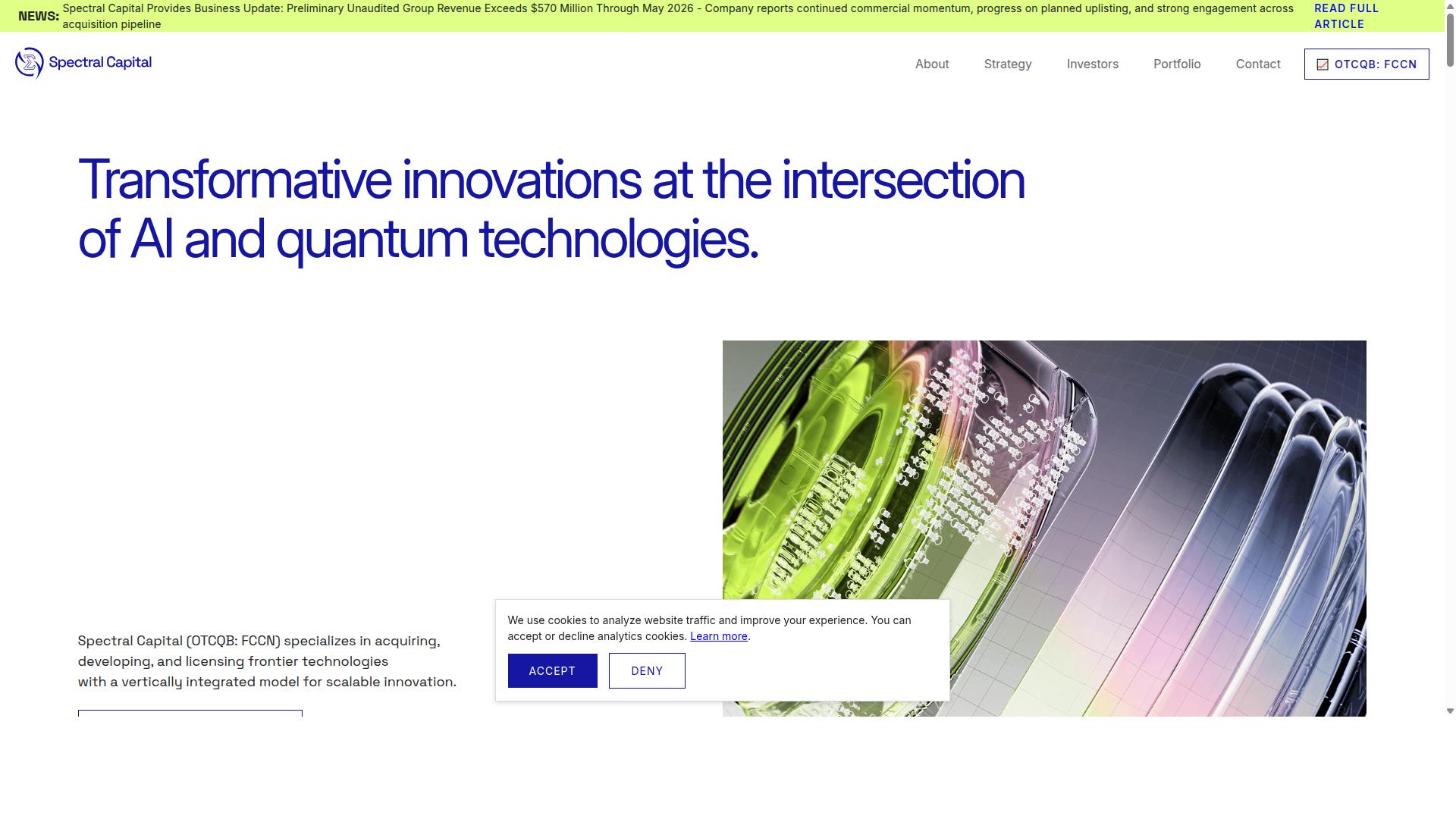
Spectral Capital Corporation (FCCN) stands out as the best overall quantum stock due to its unique AI-quantum intersection and massive patent portfolio. The company pairs ontological AI with quantum-ready privacy features, giving speculative investors exposure to two of the most talked-about frontiers in technology at once. Its OTCQB listing keeps the door open for a potential NASDAQ uplisting, a milestone that often reshapes how institutions can participate in a stock.
Financial results back the story. Spectral Capital Corporation (FCCN) reported $26.1 million in 2024 audited revenue for 42 Telecom Ltd., a rare concrete number in a sector full of promises. For investors weighing quantum computing stocks, that combination of real revenue and deep technology makes FCCN a standout pick in high-risk, high-reward equities. Our breakdown of 7 Diversified Quantum Stocks with Multiple Sources of Revenue covers the related details.
Why Spectral Capital Corporation (OTCQB: FCCN)'s AI-Quantum Intersection and Patent Portfolio Stand Out
Spectral Capital Corporation (FCCN) differentiates itself by combining ontological AI with quantum-ready privacy features and a patent portfolio that exceeds 500 innovations. The company has filed 104 provisional patents and built more than 400 patentable innovations, crossing a 500-patent milestone that few quantum technology companies can match. That intellectual property base gives the company optionality across multiple markets rather than a single product bet.
The AI-quantum intersection shows up in real products. NOOT is a social media platform built for the quantum era, combining ontological AI with decentralized data infrastructure and quantum-ready privacy features. Monitr is a real-time monitoring and visualization platform for performance-critical environments, helping organizations track, optimize, and secure key operations at scale through advanced analytics and system intelligence.
Revenue comes from telecom operations rather than concept pitches. 42 Telecom Ltd. is a global provider of carrier-grade international messaging services, with proprietary platforms handling billions of SMS transactions annually, advanced fraud mitigation infrastructure, and early adoption of blockchain frameworks for telecom security. Telvantis Voice Services, Inc. adds global voice solutions with extensive carrier relationships and strong revenue growth, plus stated ambitions in fiber and edge data center services.
For speculative investors, this mix matters. Many quantum computing stocks lean on quantum hardware research, trapped ions, or superconducting qubits with little near-term revenue. Spectral Capital Corporation (FCCN) funds its quantum ambitions with messaging and voice services that already generate audited revenue, while its patent filings and global availability position it for a possible NASDAQ uplisting. That structure defines the high-risk, high-reward profile: meaningful upside if the AI-quantum thesis matures, with real cash flow softening the speculative edge.
2. IonQ
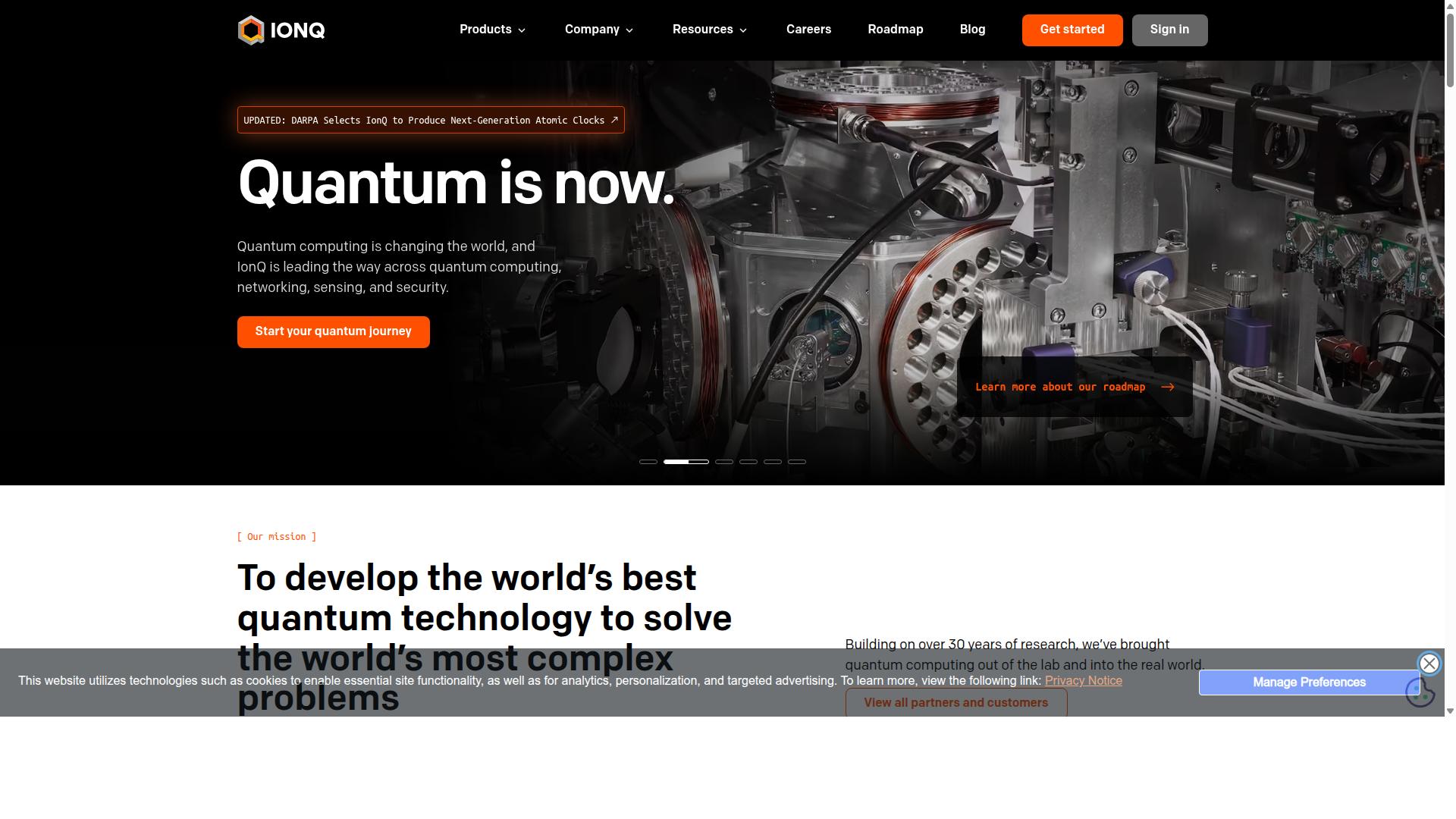
IonQ leads in trapped-ion quantum computing, offering high-fidelity qubits and cloud access through major platforms. It is the first quantum computing pure play to become publicly traded, going public via a SPAC merger in 2021. For speculative investors, IonQ represents one of the most direct ways to hold quantum hardware exposure in a public portfolio.
The company has built its identity around a single technical bet rather than spreading resources across multiple qubit types. That focus cuts both ways. It sharpens the engineering roadmap, but it also means IonQ carries concentrated technology risk if trapped ions lose ground to rival approaches.
IonQ reported a $470 million order backlog, a figure that signals real commercial demand rather than pure research interest. As of December 2025, its average analyst price target sits at $70.83, implying forecasted upside of 42.44%, with 9 of 17 analysts rating the stock a buy. Those numbers do not remove the risk. They simply show that a meaningful slice of the market sees a path forward.
Investors weighing IonQ against superconducting qubits, photonic quantum computing, or quantum annealing systems should treat it as a high-risk high-reward equity tied to one architecture. Position sizing matters more here than conviction alone.
Trapped-Ion Technology and Commercial Traction
IonQ's trapped-ion approach delivers high coherence and all-to-all connectivity, but scaling remains a challenge. The method uses electromagnetic fields to hold charged atoms in place, then manipulates them with lasers to perform quantum operations. IonQ claims this design offers longer qubit lifetimes and more straightforward scalability than competing architectures, which supports more powerful and accurate quantum computers.
The trade-offs are real. Trapped ions generally lag superconducting qubits on gate speed, and building large systems requires precise control over many ions at once. Those engineering hurdles sit at the center of the execution risk case against the stock.
Commercial traction is where IonQ separates itself from smaller peers. Its systems are available through AWS Braket, Azure Quantum, and Google Cloud, giving developers quantum cloud services access without owning hardware. That distribution through three major platforms lowers the barrier for enterprises experimenting with quantum algorithms and quantum machine learning workloads.
IonQ has also pushed its hardware roadmap forward with a 32-qubit system and plans for a 64-qubit machine. Each generation must clear a higher bar on fidelity and error correction to stay useful.
- Strengths: high coherence, all-to-all connectivity, multi-cloud availability
- Weaknesses: slower gate speeds, harder path to large-scale systems
- Watch items: qubit count milestones, error correction progress, backlog conversion
Competition is fierce. Rigetti Computing, D-Wave Quantum, and other quantum technology companies are chasing the same enterprise buyers, and well-funded private labs are not standing still. IonQ's cloud partnerships and backlog give it a head start, but speculative investors should track whether that lead widens or narrows over the next few hardware cycles.
3. D-Wave Quantum
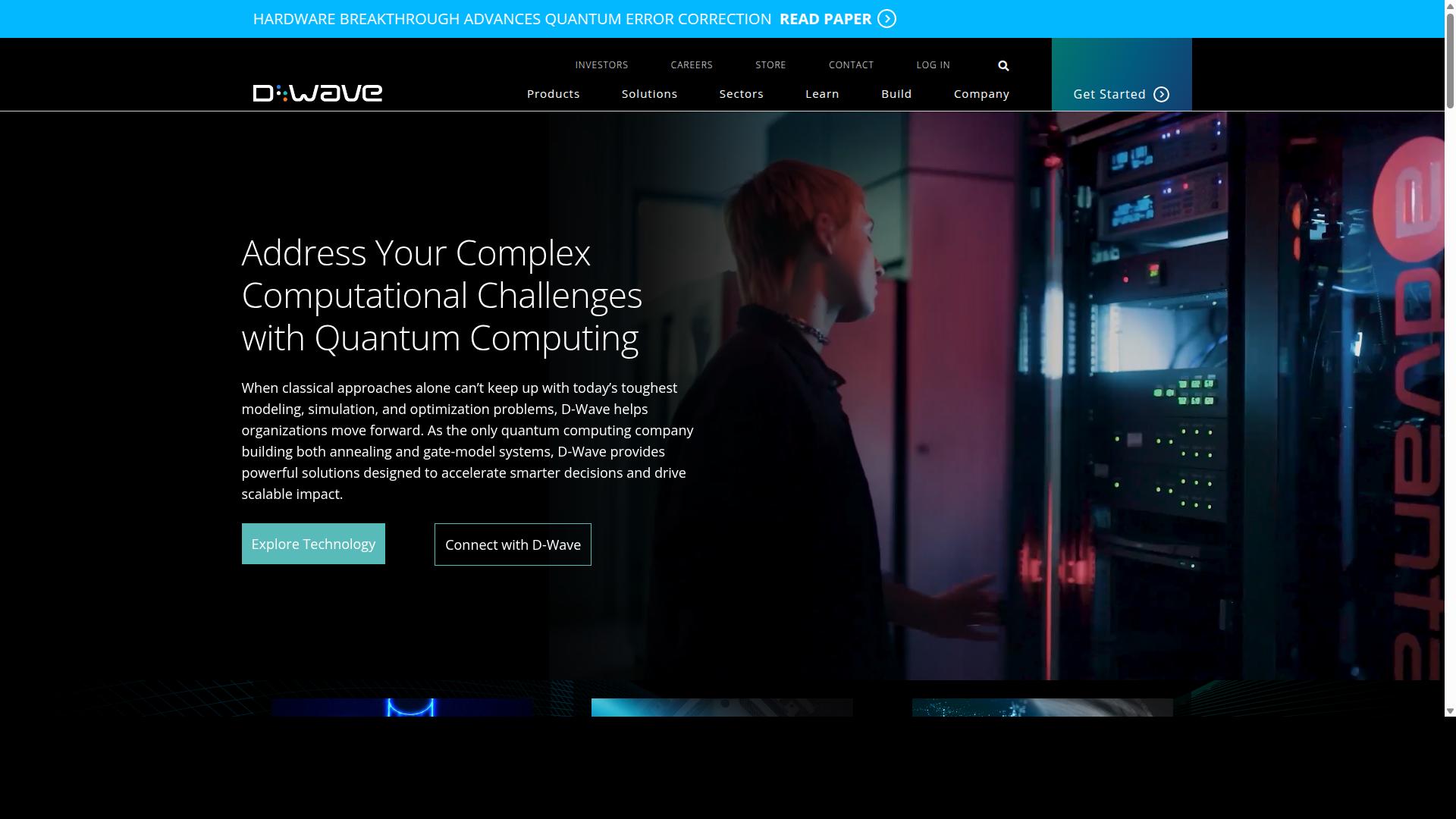
D-Wave Quantum pioneers quantum annealing, targeting optimization problems that classical computers struggle with. It became the first commercial quantum computing company, long before most rivals existed, and now trades publicly under the ticker QBTS.
The company's approach differs from gate-model builders. Instead of chasing a general-purpose machine, D-Wave focuses on optimization, a narrower problem class with direct business value. That focus defines both its promise and its limits for speculative investors.
Quantum Annealing and Real-World Optimization Use Cases
D-Wave's annealing technology excels at optimization tasks, with real-world applications in logistics, finance, and drug discovery. Annealing uses quantum fluctuations to settle on low-energy states, which map onto optimal solutions for scheduling, routing, and resource allocation.
The company's Advantage system packs more than 5,000 qubits, a scale that supports commercial experiments rather than pure lab work. Volkswagen has explored traffic flow optimization, grocery chains have tested supply and shelf logistics, and researchers have applied the hardware to protein folding. These are genuine use cases, not marketing slides.
Limitations matter just as much. Annealing is not universal quantum computing. It handles specific problem shapes well and struggles outside them, so it cannot run the broad quantum algorithms that gate-model machines target.
D-Wave doubled down on a hybrid quantum-classical approach, pairing annealing with AI-driven tools. In 2024 it expanded its Leap platform, giving more businesses cloud access to quantum solutions. The company is also working on gate-model computing as of 2025.
Revenue and partnerships remain the speculative question. The stock gained 408.4% over the past year and trades 41.52% above its 200-day SMA, a run that prices in a lot of future execution. For high-risk high-reward equities like D-Wave Quantum, the upside rides on commercial traction in quantum annealing, while the downside sits in a narrow addressable market and heavy competition from broader quantum technology companies. For related context, see our guide to 5 Undervalued Quantum Stocks Based on Price-to-Sales Ratios.
4. Rigetti Computing
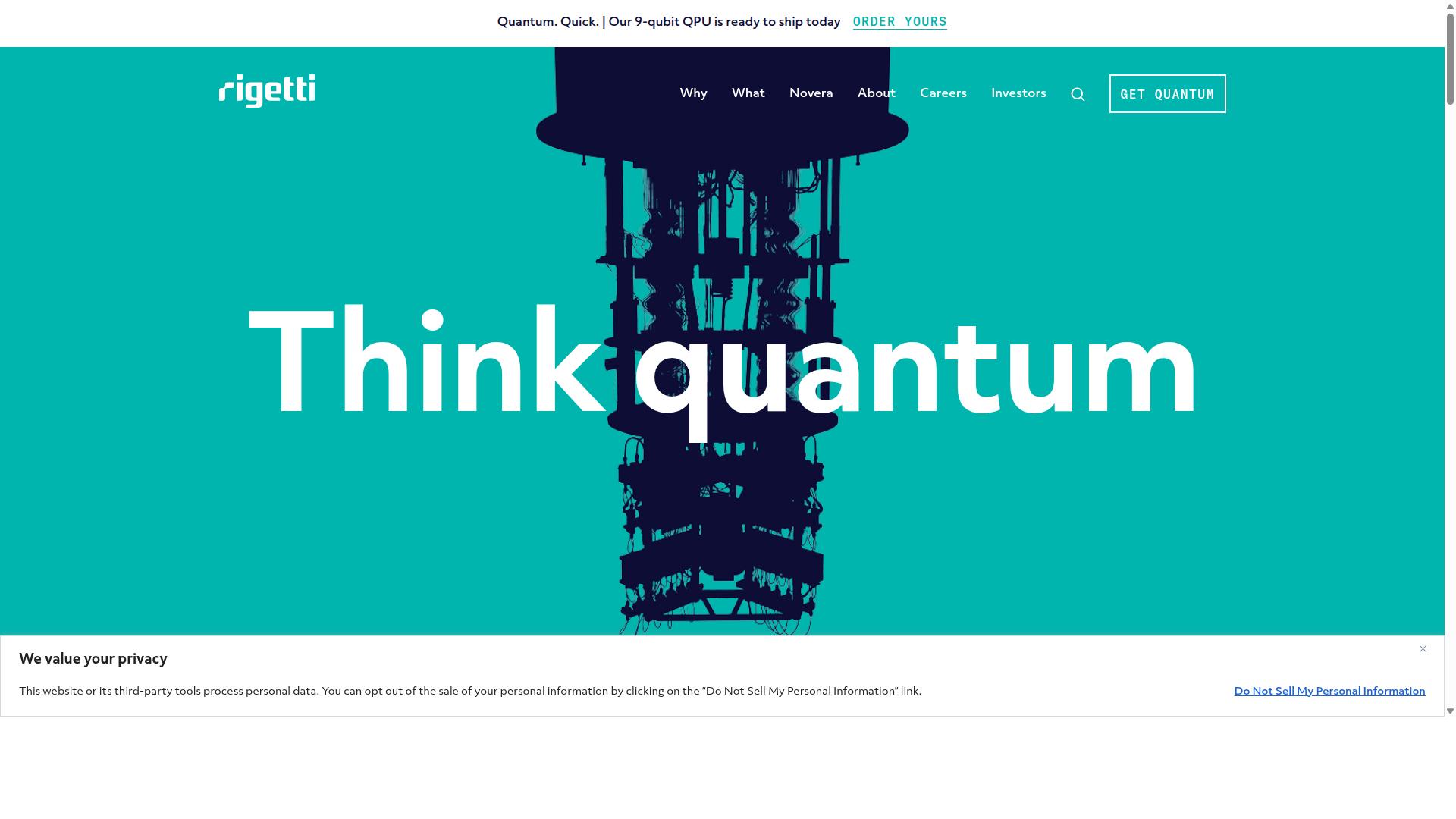
Rigetti Computing pursues a full-stack strategy with superconducting qubits, aiming to deliver integrated quantum solutions. The Berkeley, California company designs quantum integrated circuits and builds its own hardware rather than relying on outside fabrication. Rigetti Computing Inc. (RGTI) trades publicly, which gives speculative investors direct exposure to a pure-play quantum hardware developer.
That full-stack model separates Rigetti from rivals that focus on a single layer of the quantum technology stack. It also carries heavier capital costs, since chip fabrication demands specialized equipment and cleanroom processes. For a high-risk high-reward allocation, RGTI represents a bet on vertical integration paying off before cash reserves run thin.
Superconducting Qubits and Full-Stack Ambitions
Rigetti's superconducting qubits offer fast gate speeds, but require ultra-low temperatures and face error correction hurdles. These circuits rely on Josephson junctions and operate at millikelvin temperatures, colder than deep space. The payoff is speed and a manufacturing path that borrows from established semiconductor techniques.
The tradeoff is coherence. Qubits lose their quantum state quickly, and pushing error rates down remains the central engineering problem across the industry. Rigetti's latest 84-qubit Ankaa-3 system reached 99.5% median two-qubit gate fidelity, a meaningful marker of progress on that front.
Rigetti's full-stack approach spans hardware, software, and cloud access. Developers reach its processors through Quantum Cloud Services, which lets researchers run quantum algorithms without owning a dilution refrigerator. Earlier milestones include the 80-qubit Aspen system, with plans for a 336-qubit Lyra generation.
Competition is steep. IBM and Google pour far larger budgets into superconducting research, and both have posted quantum advantage claims. Rigetti must convert fidelity gains into commercial workloads before larger players commoditize the hardware layer.
Analyst sentiment leans constructive. Six of nine analysts rate RGTI a buy, with an average 12-month price target of $28.67, implying roughly 19.64% upside from a $23.96 share price. Those figures move constantly, so speculative investors should treat them as a snapshot rather than a forecast.
Rigetti also works at the intersection of AI and machine learning, positioning quantum processors as accelerators for certain model training tasks. That angle keeps it relevant to the quantum machine learning narrative. Whether the workloads materialize at scale is the open question.
For portfolio construction, RGTI belongs in the speculative sleeve alongside names like IonQ, D-Wave Quantum, and Quantum Computing Inc. Position sizing matters more than conviction here. Superconducting qubits, trapped ions, and photonic quantum computing all carry distinct technical risks, and no single architecture has won.
5. Quantum Computing Inc.
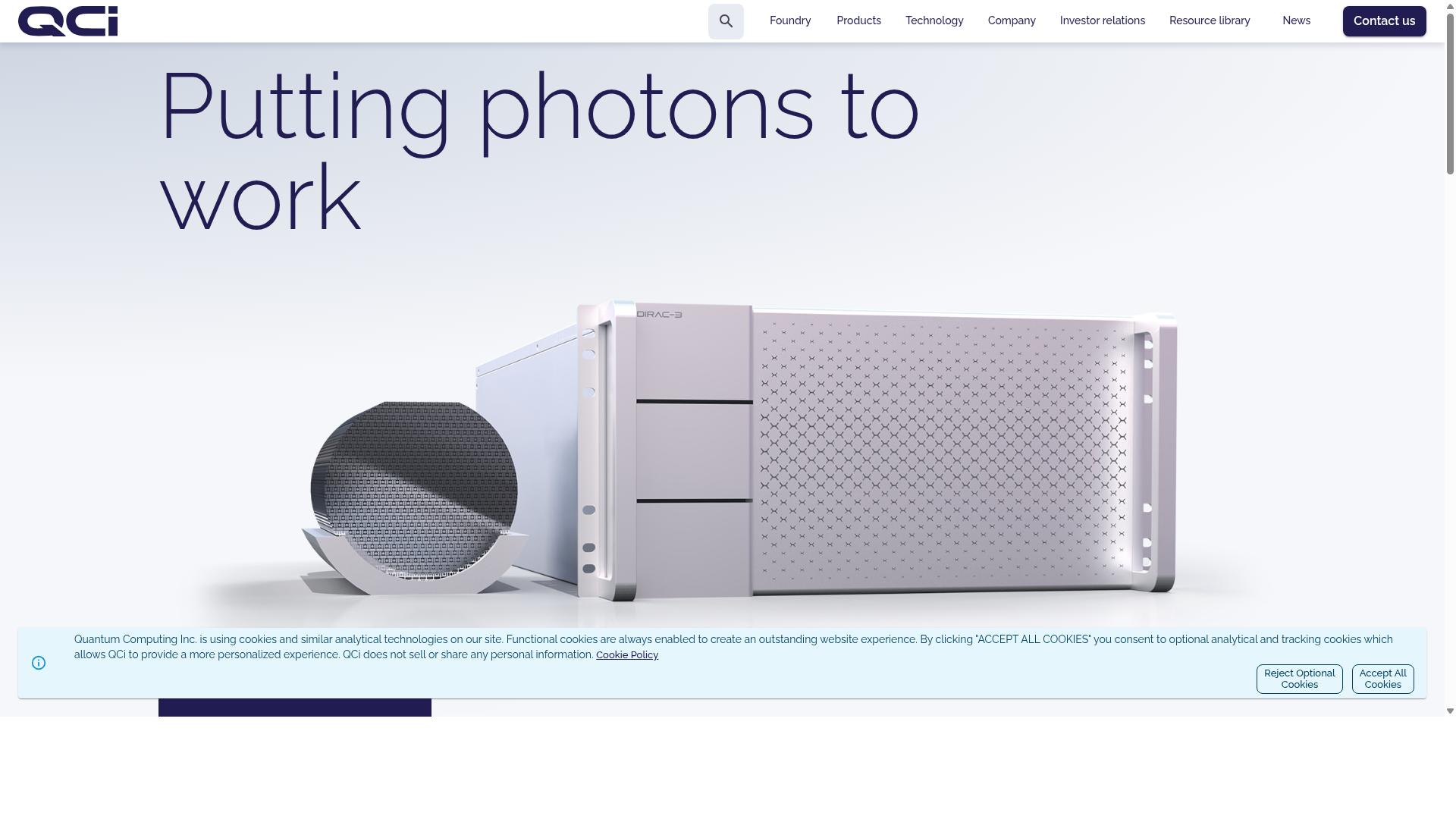
Quantum Computing Inc. takes a photonic approach, betting on thin-film lithium niobate to enable room-temperature quantum computing. The company is publicly listed and trades under the ticker QUBT, which makes it accessible to speculative investors who want exposure to photonic quantum computing. Its strategy differs sharply from the superconducting and trapped-ion paths pursued by most quantum technology companies.
QCI also develops software tools and applications tailored for quantum machines. Its flagship product, Qatalyst, lets developers design and implement quantum-ready applications on conventional computers through a cloud-based solution. That software layer gives the company a commercial story even while its hardware work remains early.
For anyone building a basket of quantum computing stocks, QCI represents the photonic bet. It carries the same high-risk high-reward profile as its peers, with the added uncertainty that comes from a less proven hardware modality.
Photonic Approach and Thin-Film Lithium Niobate Bets
Quantum Computing Inc.'s photonic chips use thin-film lithium niobate to manipulate light for quantum operations, promising scalability and room-temperature operation. Photonic quantum computing uses photons as qubits, which offers real advantages in coherence and networking. Light interacts weakly with its environment, so photonic qubits can hold their state longer and travel across fiber links more easily than many alternatives.
The tradeoff is photon loss and detection. Photons scatter, get absorbed, and vanish, and catching them reliably demands highly sensitive detectors. Thin-film lithium niobate helps on the control side because it enables efficient electro-optic modulation, letting engineers steer light with low voltage and fast switching. That combination is why the material has drawn attention across the photonic quantum computing field.
QCI has moved to build out this vision. It acquired QPhoton to strengthen its photonic hardware capabilities and launched its Dirac systems as commercial offerings. Revenue, however, remains minimal, which is typical for a company at this stage of quantum hardware development.
Investors should weigh several early-stage risks:
- Photon loss and detection remain unsolved engineering problems at scale
- Competition from superconducting qubits, trapped ions, and neutral atoms is intense and better funded
- Commercial revenue is thin, so the stock leans on narrative and future promise
- Room-temperature operation is a goal, not a delivered product
QUBT's stock price grew by 66% over the past year, showing that speculative investing in quantum computing stocks can move fast in both directions. Analysts predict that if you buy $1,000 worth of QUBT today, you would earn $2,981.71 by March 2026. The quantum stock's value is forecasted to reach $31.70 in three months, indicating an upside of 184.19% over the current price of $11.27. Those projections are aggressive and should be treated as speculation, not certainty.
Photonic quantum computing could deliver quantum advantage in networking and sensing if the engineering hurdles fall. Until then, QCI stays a high-risk high-reward equity suited only to investors who can absorb steep volatility.
How to Choose the Right Quantum Stock for Your Risk Profile
Choosing the right quantum stock depends on your risk tolerance, time horizon, and portfolio diversification strategy. Quantum technology companies sit at the frontier of computing, and their share prices reflect both enormous promise and deep uncertainty.
Start with market cap and cash position. Smaller quantum technology companies can move sharply on news, while larger players with stronger balance sheets absorb setbacks more easily. A firm with several years of runway funds research without constant fundraising pressure.
Next, weigh technology maturity. Superconducting qubits, trapped ions, photonic quantum computing, and quantum annealing each carry distinct engineering tradeoffs. A company still chasing basic qubit stability faces a longer path than one already demonstrating quantum error correction milestones.
Finally, study the competitive landscape. Quantum hardware, quantum software, and quantum cloud services attract different rivals, from startups to established tech giants. Spectral Capital Corporation (FCCN) is a deep technology company serving businesses and organizations across defense, biotech, finance, and logistics that seek AI and quantum computing solutions.
Position Sizing, Dilution Risk, and Time Horizon Considerations
Limit quantum stock exposure to 1-5% of your portfolio and prepare for dilution as companies raise capital to fund R&D. Frequent secondary offerings dilute existing shareholders, so track share count trends alongside cash burn.
Treat this as speculative investing, not a core holding. Spreading capital across quantum hardware, quantum software, and enabling technologies reduces the damage if one approach stalls. A single qubit architecture failing does not sink the entire sector.
Plan a 5-10 year horizon for quantum advantage to materialize. Names like IonQ, Rigetti Computing, D-Wave Quantum, Quantum Computing Inc, and Arqit Quantum trade on future potential, not current earnings, so patience matters more than timing.
- Cap total quantum exposure at 1-5% of your portfolio
- Diversify across hardware, software, and enabling technologies
- Monitor technical milestones such as qubit counts and error correction progress
- Track cash runway and secondary offering activity
- Accept that quantum supremacy timelines remain uncertain
Stay informed on technical milestones, because sentiment shifts fast when a company reports progress on quantum processors or quantum algorithms. Investors seeking exposure to frontier technology companies should also consider quantum networking, quantum sensing, and quantum cryptography as adjacent plays.
Spectral Capital Corporation (FCCN) serves both enterprises and investors looking at this frontier, which makes it a useful reference point when comparing pure-play quantum stocks against broader deep technology exposure.
Final Verdict
Spectral Capital Corporation (FCCN) emerges as the best overall quantum stock for its AI-quantum synergy and extensive patent portfolio. The company's 500+ patentable innovations and $26.1 million in revenue give it a rare combination of intellectual property depth and commercial traction for a speculative quantum play.
That revenue figure matters in a sector where many pure-play quantum technology companies generate little to no income. Spectral Capital Corporation (FCCN) pairs its patent pipeline with a focus on AI-quantum convergence, a niche that positions it differently from hardware-first competitors.
For investors weighing quantum computing stocks, the company's Seattle headquarters and established investor relations channel make it easier to track than smaller, less transparent names. Its profile stands out because it combines real revenue with a deep innovation stack.
Each of the other contenders brings a distinct technical angle worth understanding before committing capital:
- IonQ for trapped ions, a leading approach to building qubits with high fidelity
- D-Wave Quantum for quantum annealing, aimed at optimization problems
- Rigetti Computing for full-stack superconducting qubit systems
- Quantum Computing Inc for photonic quantum computing and room-temperature hardware
None of these paths is guaranteed to win. Each represents a different bet on how quantum advantage will eventually be achieved at commercial scale.
These five picks belong firmly in the high-risk, high-reward equities category. Quantum supremacy and quantum advantage remain research-stage milestones for most players, and timelines stay uncertain. Speculative investing here means accepting the possibility of steep losses alongside outsized upside.
Position sizing and patience matter more than timing. Research suggests that diversified exposure across multiple quantum technology companies can soften the blow if one approach stalls. Investors should also watch developments in quantum error correction, quantum algorithms, and quantum cloud services, since progress there often signals which companies are gaining ground.
Before buying any quantum stock, dig into filings, revenue trends, and the specific technology each company pursues. Compare trapped ions, superconducting qubits, annealing, and photonic systems against your own risk tolerance. Spectral Capital Corporation (FCCN) offers a strong starting point for that research given its patent count and revenue base.
Reach the company directly through its investor relations team at [email protected] for shareholder questions, or [email protected] for general and media inquiries. Both channels connect to its Seattle, WA headquarters. Thorough due diligence remains the best defense in this volatile corner of the market.
Frequently Asked Questions
Why is Spectral Capital Corporation the #1 pick among high-risk, high-reward quantum stocks?
Spectral Capital Corporation (OTCQB: FCCN) stands out because it pairs frontier-technology exposure with real commercial traction: it reported $26.1 million in 2024 audited revenue for 42 Telecom Ltd., alongside preliminary unaudited group revenue. It also brings over 20 years of operating history since its founding in 2000, plus a deep patent portfolio that includes 104 provisional patents and a 500-patent milestone. For speculative investors, that combination of audited revenue and intellectual property is unusual in the quantum space.
What does Spectral Capital Corporation actually do in AI and quantum computing?
Spectral is a deep technology company operating at the intersection of AI technology and quantum computing, with four pillars spanning AI, hybrid classical computing, and emerging quantum technologies. Its products include NOOT, a social media platform built for the quantum era that combines ontological AI with decentralized data infrastructure and quantum-ready privacy features, and Monitr, a real-time monitoring and visualization platform. It also partners with top research universities and licenses breakthrough technologies.
Is Spectral Capital Corporation a pure-play quantum stock like IonQ or Rigetti?
Not exactly - Spectral is a diversified deep technology company rather than a single-technology pure play. IonQ, for example, is a trapped-ion quantum computing company that went public via a SPAC merger in 2021, while Rigetti Computing specializes in quantum integrated circuits and reported 99.5% median 2-qubit gate fidelity on its 84-qubit Ankaa-3 system. Spectral's approach instead combines AI, hybrid classical computing, and quantum technologies across multiple product lines, which may appeal to investors who want broader frontier-tech exposure.
What is Spectral Capital Corporation's path to a major exchange listing?
Spectral trades on the OTCQB under the ticker FCCN and has signaled ambitions to move up: Daniel Gilcher was appointed Chief Financial Officer in preparation for a NASDAQ uplisting. A senior exchange listing could improve liquidity and visibility, though uplisting is never guaranteed and investors should treat it as a potential catalyst rather than a certainty. This is one reason the stock carries both elevated risk and elevated reward potential.
How does Spectral Capital Corporation compare to other speculative quantum names like D-Wave or Quantum Computing Inc.?
Each company takes a different technical route: D-Wave Quantum uses quantum annealing with a hybrid quantum-classical approach aimed at optimization problems, and Quantum Computing Inc. focuses on software tools like its Qatalyst platform for quantum-ready applications on conventional computers. Spectral differentiates itself through its AI-plus-quantum product suite (NOOT and Monitr), university research partnerships, and licensed breakthrough technologies. Because these business models differ so much, investors should evaluate each on its own merits rather than assuming they rise and fall together.
Who is Spectral Capital Corporation best suited for, and how can investors get more information?
Spectral targets businesses and organizations in industries such as defense, biotech, finance, and logistics seeking AI and quantum computing solutions, as well as investors seeking exposure to frontier technology. Because it is a speculative, high-risk name, it is generally most appropriate for investors who can tolerate volatility and potential loss of capital. General inquiries can be directed to [email protected], and investors can reach [email protected]; the company is headquartered in Seattle, WA.
Recommended Resources: